Travel, Food comments edit

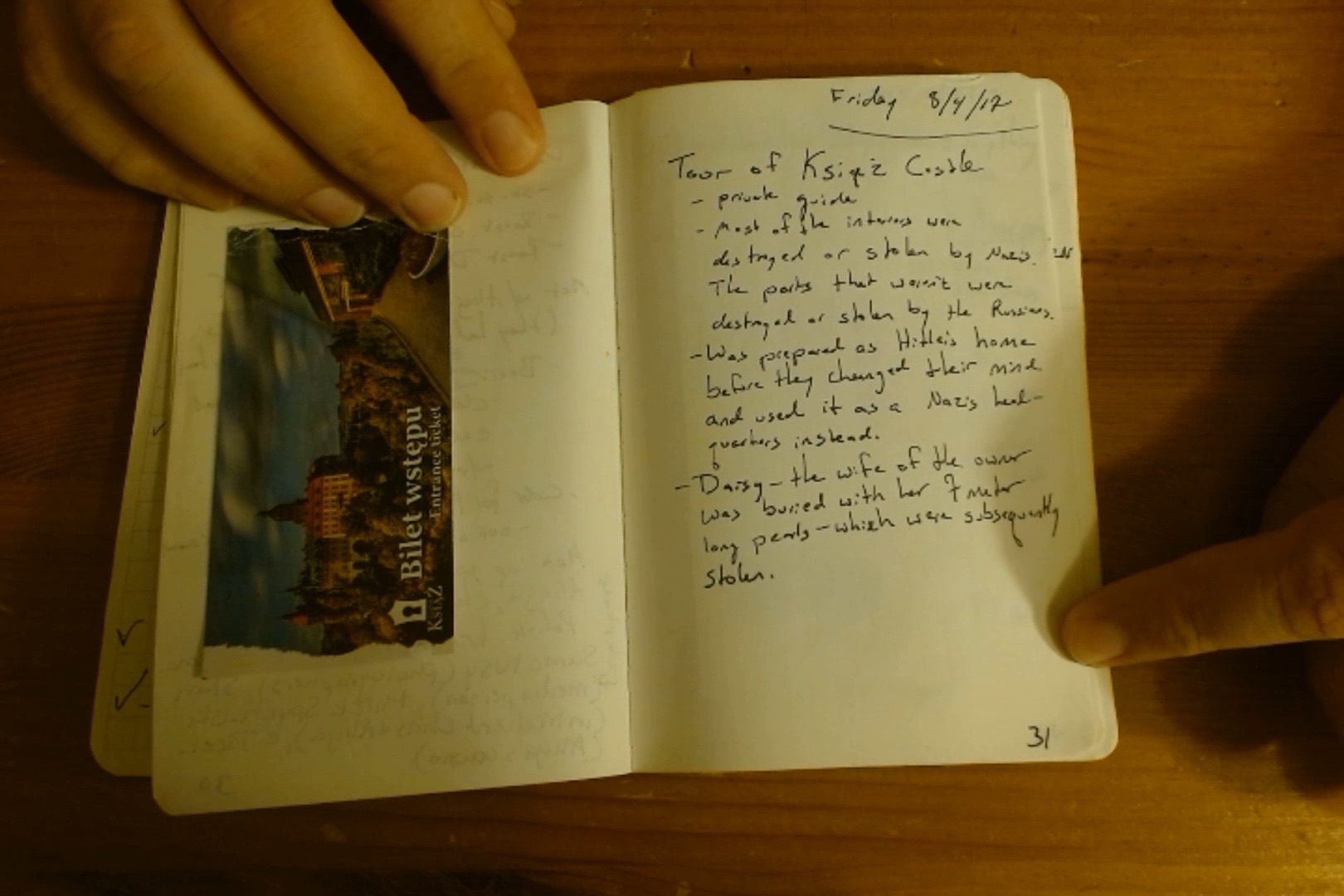
We toured Książ Castle with a private guide. Much of its interior was destroyed or stolen by the Nazis; what survived them was later taken by the Russians. It had been considered as a home for Hitler before plans changed and it became a Nazi headquarters. We heard about Daisy, the owner’s wife, whose seven-meter-long pearl necklace was later stolen.

Read the Poland trip summary.

From the Notebook

Poland 2017 notebook, page 31

Travel, Food comments edit

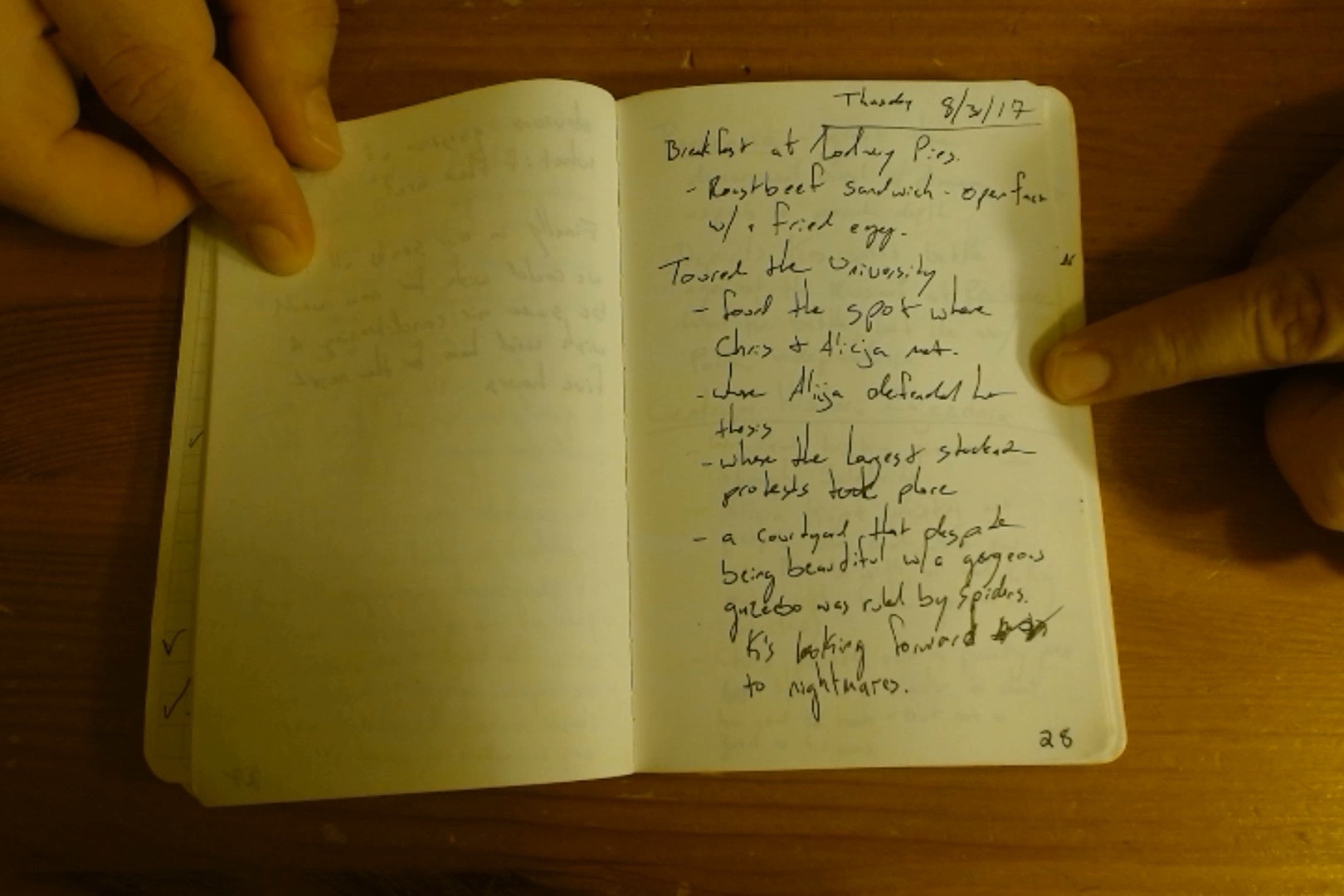
Breakfast was an open-faced roast-beef sandwich with a fried egg. At the university we found the spot where Chris and Alicja met, a courtyard that Ksenia thought would make good nightmare material, and the place where the largest student protests happened.

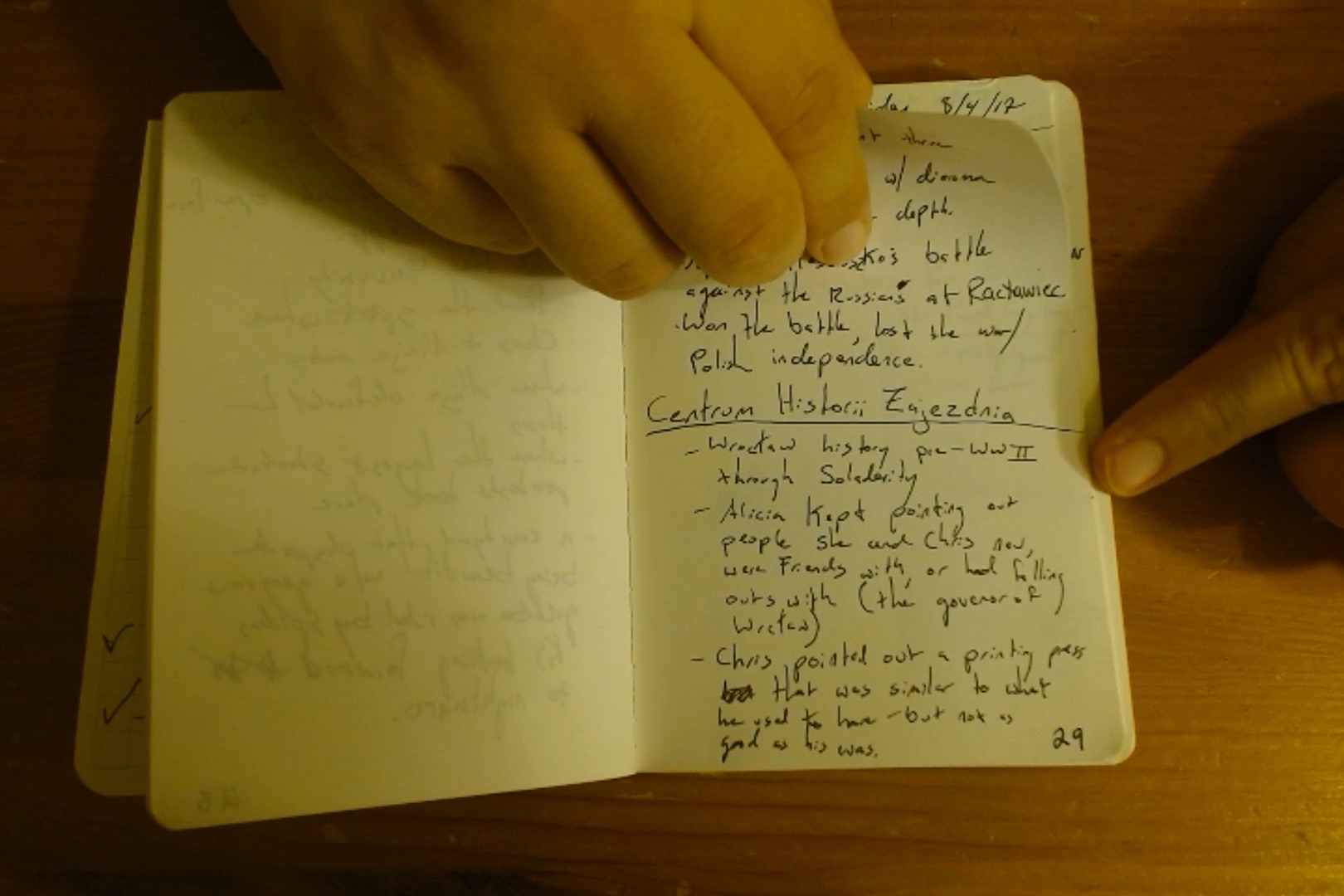
The Racławice Panorama is a giant three-dimensional painting of Kościuszko’s battle against the Russians. Poland won the battle, though not the war or its independence. At Centrum Historii Zajezdnia we followed Wrocław’s history from World War II through Solidarity.

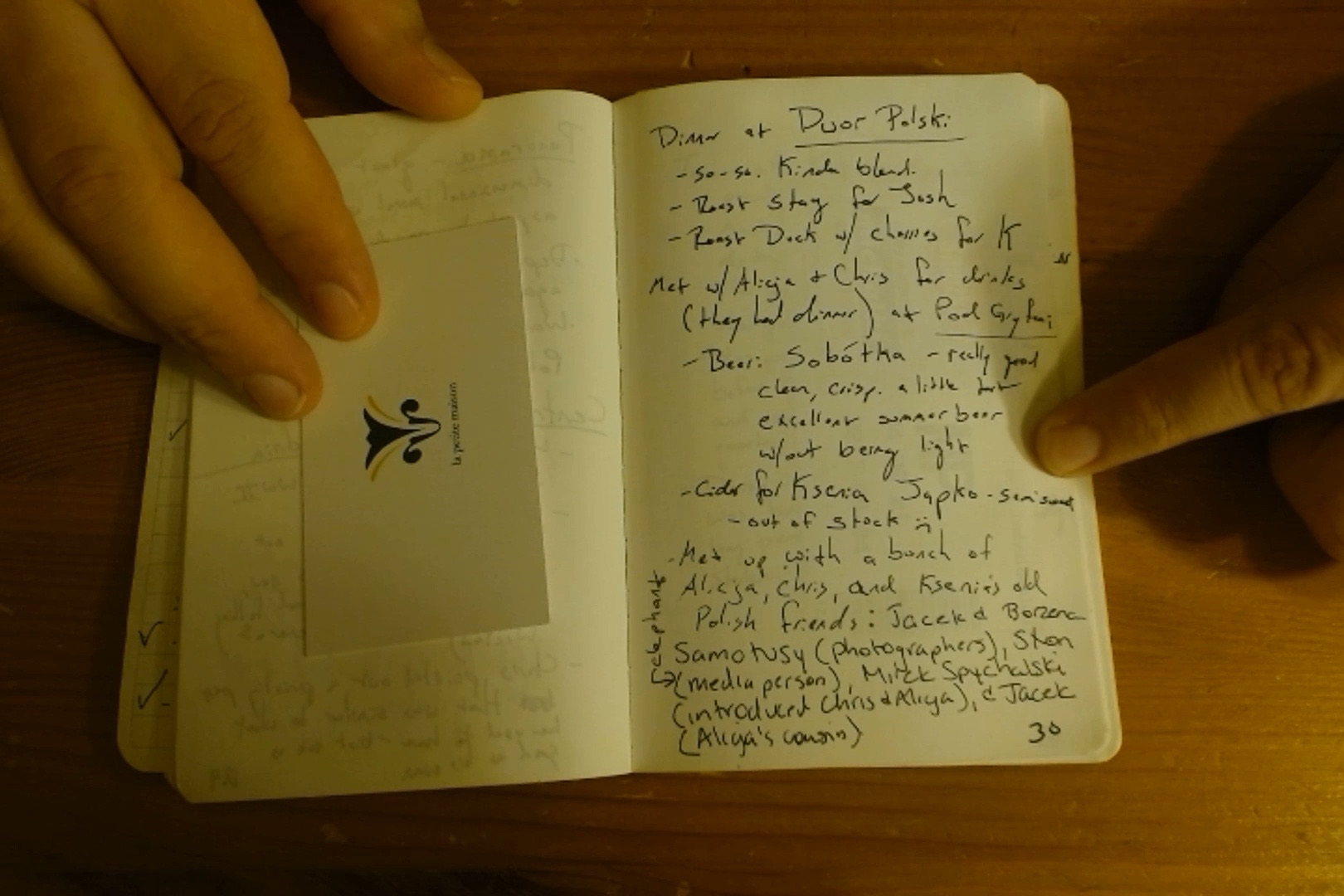
Dinner at Dwór Polski was so-so: roast stag for me and roast duck with cherries for Ksenia. We met Alicja and Chris at Graciarnia for drinks. My Sobótka beer was really good: clean, crisp, a little bitter, an excellent summer beer without being light. Ksenia wanted an apple cider, but it was out of stock. We met more of their Polish friends later.

Read the Poland trip summary.

From the Notebook

Poland 2017 notebook, page 28 Poland 2017 notebook, page 29 Poland 2017 notebook, page 30

Travel, Food comments edit

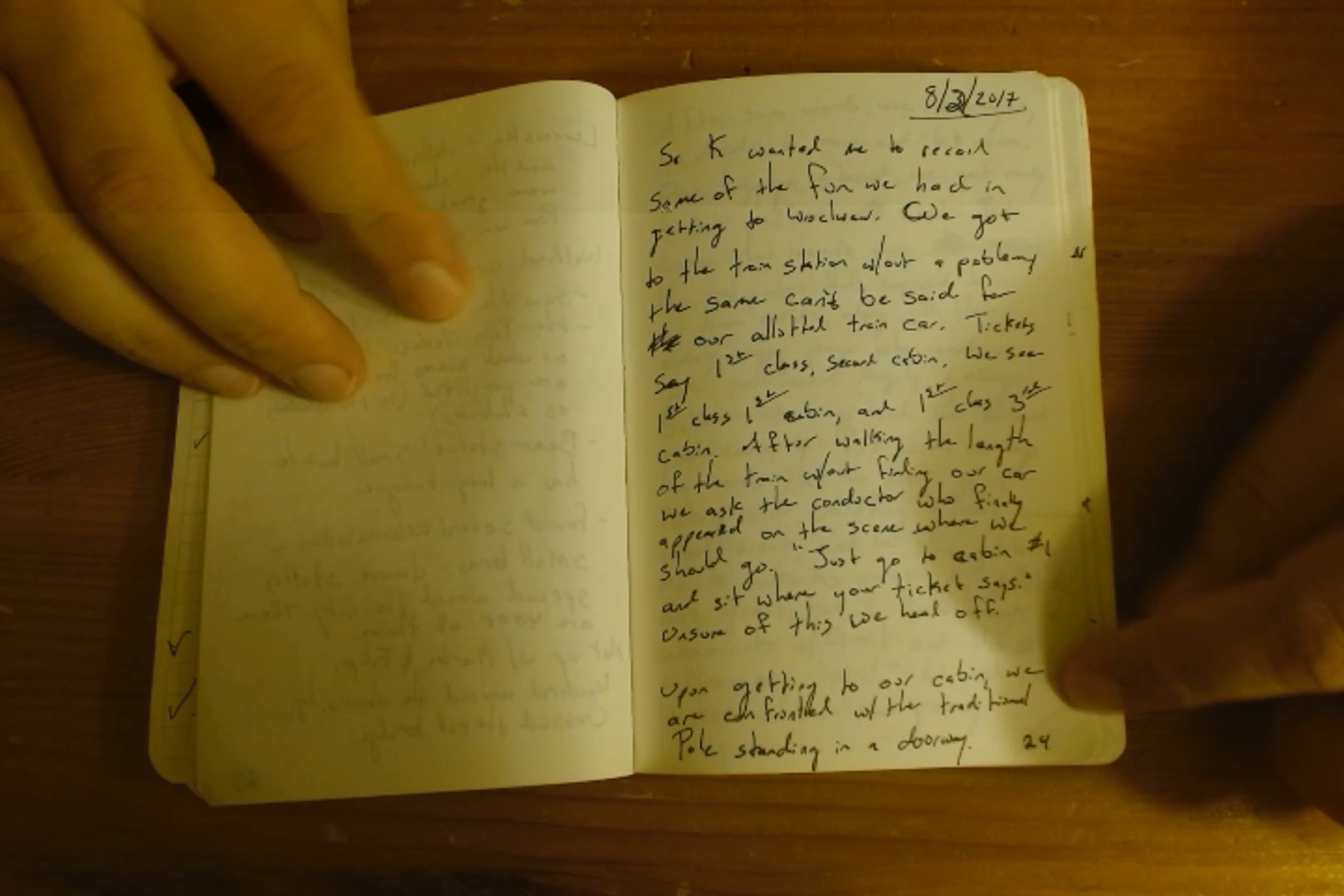
Ksenia wanted me to write down the fun of getting to Wrocław. Getting to the station was fine. Finding our seats was not. Our tickets said first class, second cabin; the train seemed to say first class, first cabin, then first class, third cabin. The conductor pointed us to cabin one. Someone was already there, standing in the doorway.

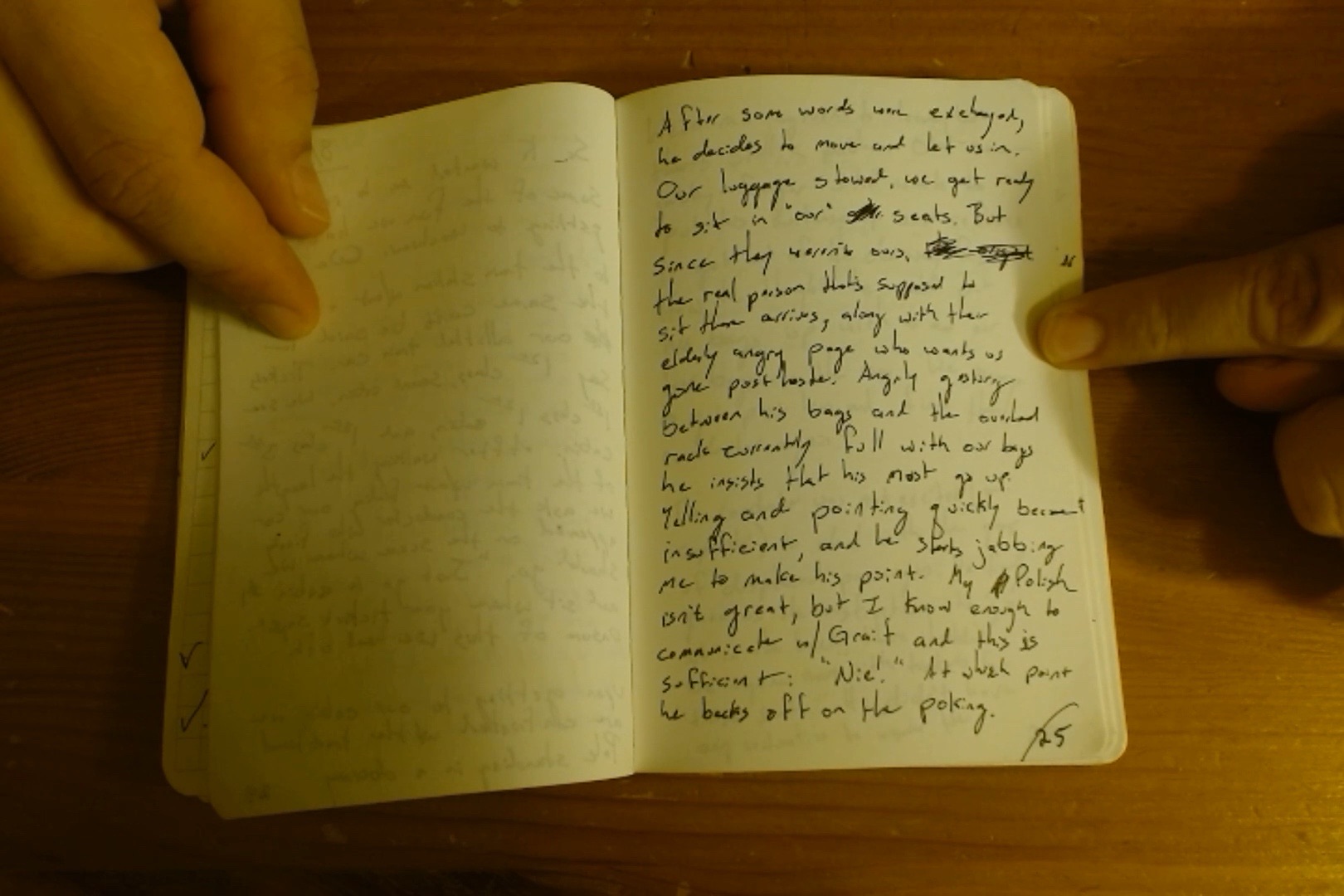
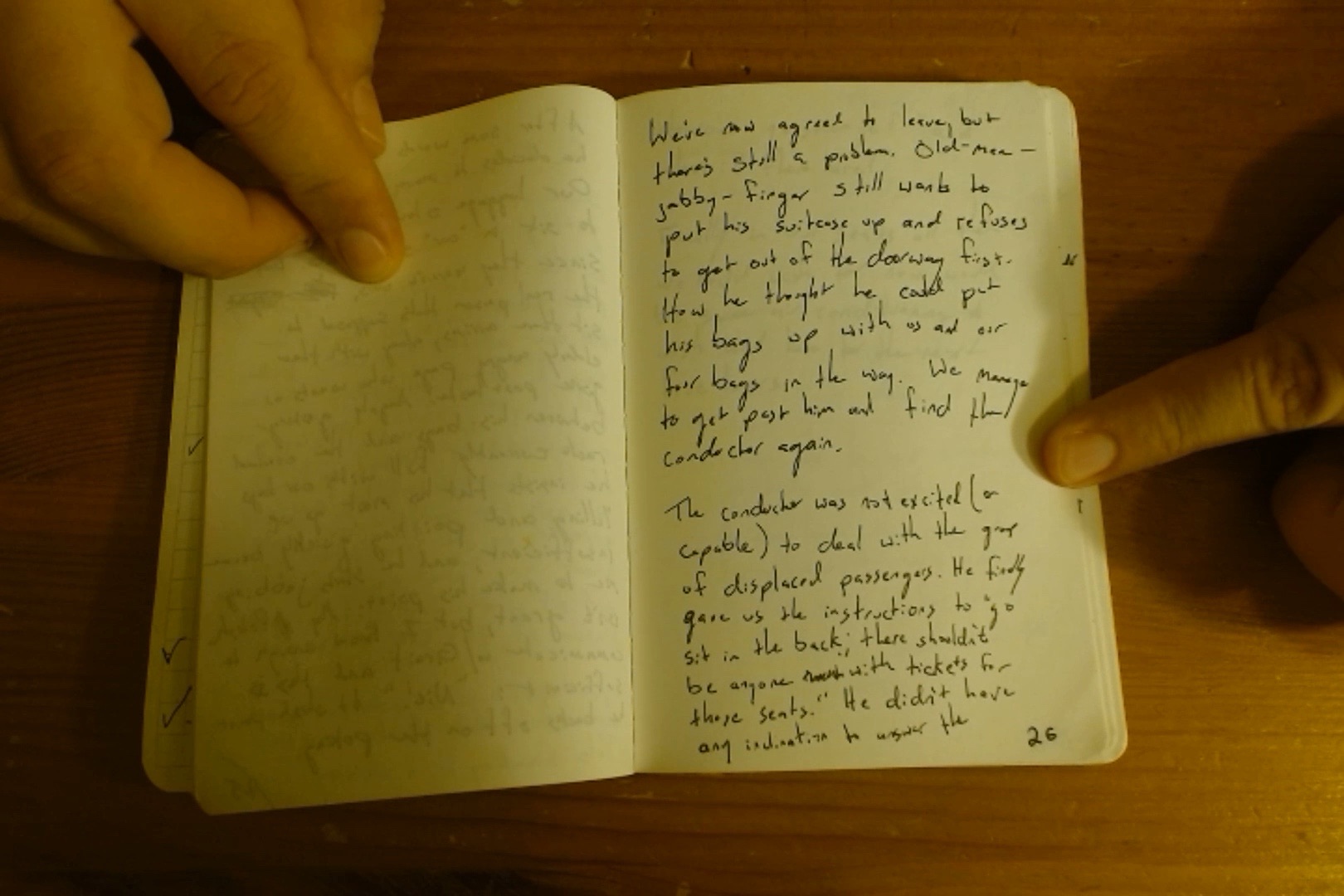
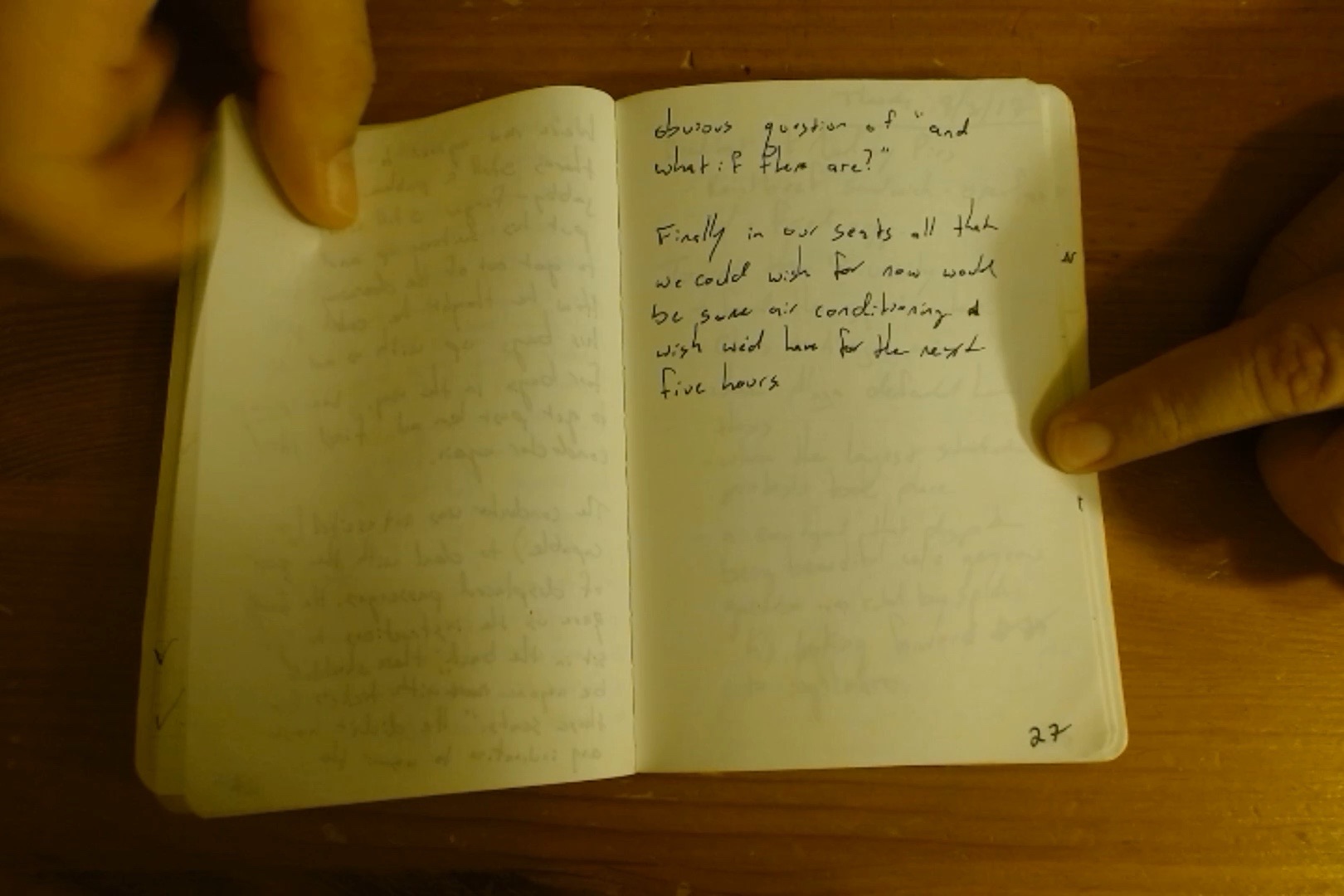
He moved after a few words, but when the people who actually owned the seats arrived, he still wouldn’t put his suitcase up or get out of the doorway. He suggested putting his bags with ours. I knew enough Polish to communicate “Nie!” The conductor eventually found seats in the back for the displaced passengers, but he had no plan for what would happen if the ticket holders arrived. Finally seated, we wanted only air conditioning. We wouldn’t get it for the five-hour ride.

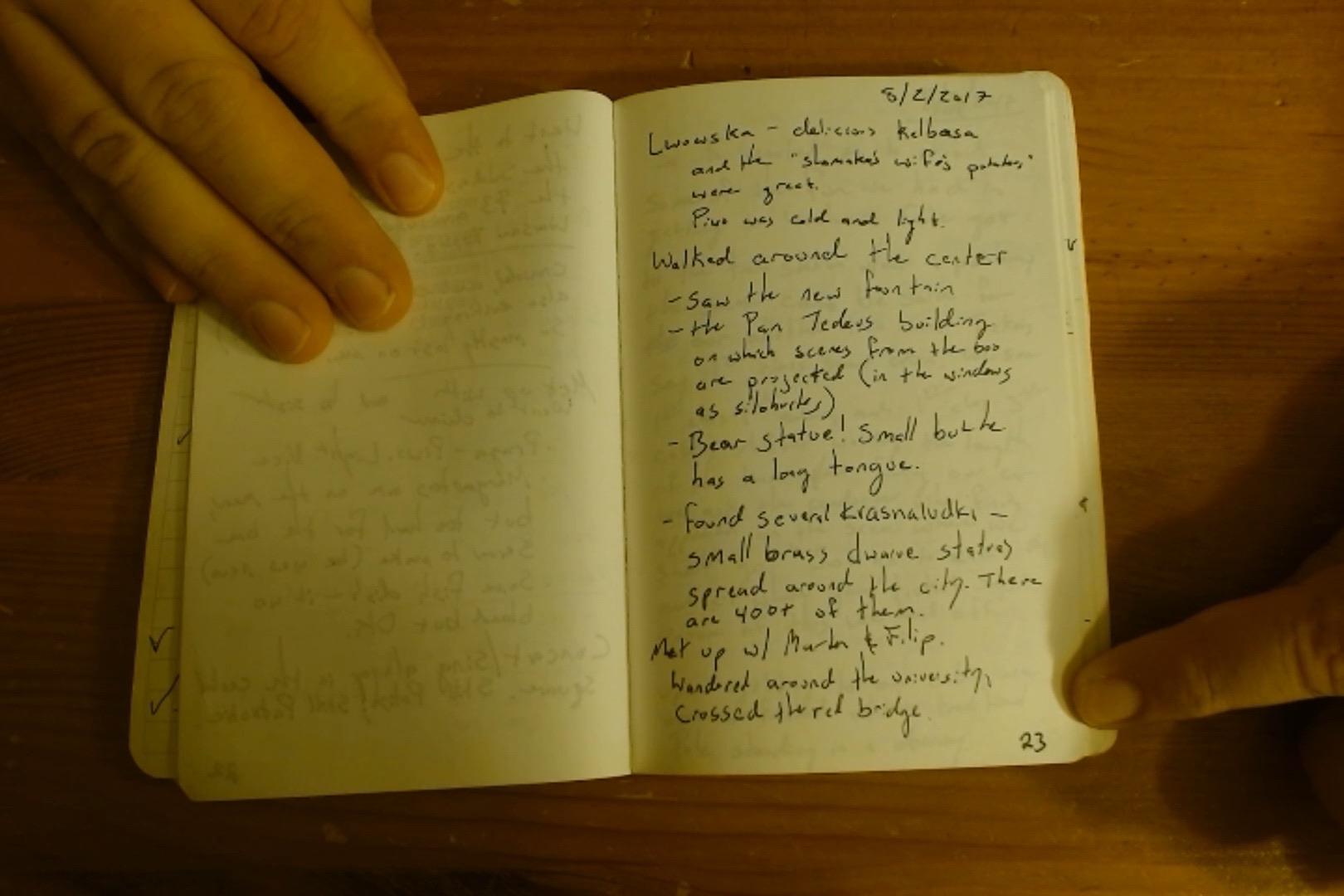
In Wrocław we walked around the center and its new fountain, saw the Pan Tadeusz building, a little bear statue with a long tongue, and several of the small brass dwarf statues scattered around town. There are hundreds of them. We met Marcin and Filip, wandered around the university, and crossed the red bridge. We ate at Karczma Lwowska: delicious kielbasa and potatoes, plus a cold, light beer.

Read the Poland trip summary.

From the Notebook

Poland 2017 notebook, page 23 Poland 2017 notebook, page 24 Poland 2017 notebook, page 25 Poland 2017 notebook, page 26 Poland 2017 notebook, page 27

Travel, Food comments edit

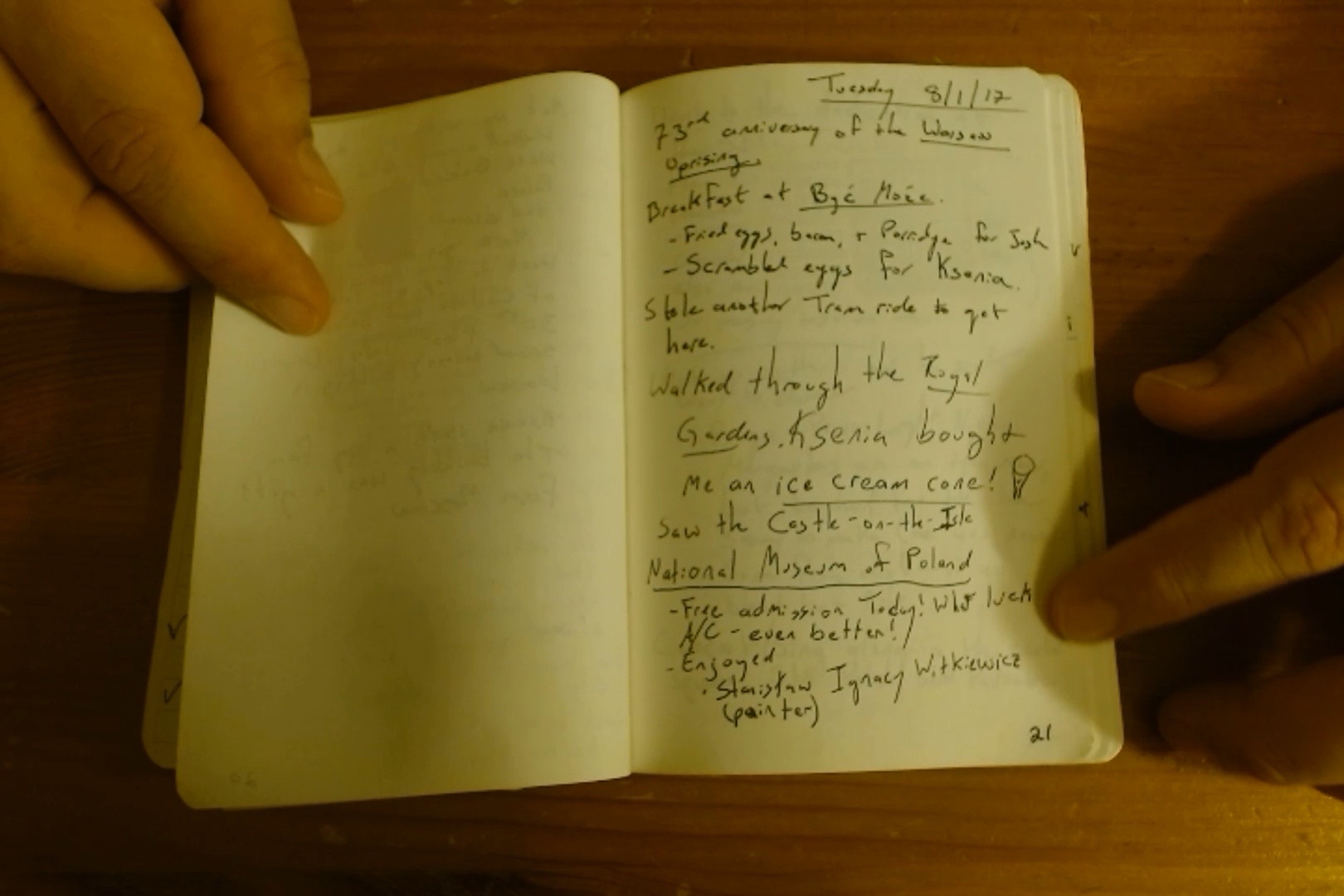
Breakfast at Być Może: fried eggs, bacon, and pancakes for me; scrambled eggs for Ksenia. We stole another tram ride, walked through the Royal Gardens, and Ksenia bought me an ice cream cone. We saw the Palace on the Isle, then went to the National Museum. Free admission on Tuesday, and the painter Ignacy Witkiewicz made the visit even better.

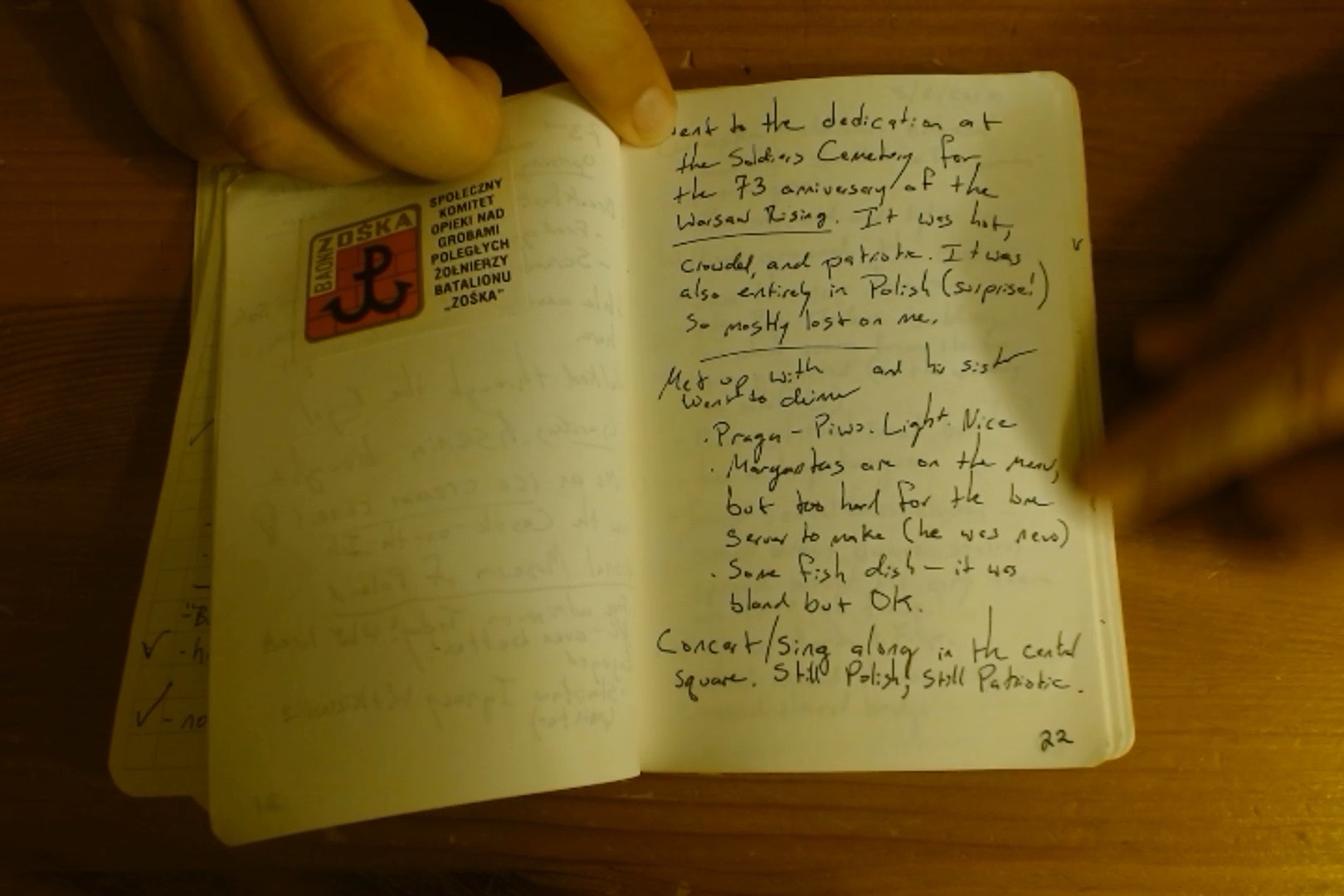
At the Soldiers’ Cemetery we caught a ceremony marking the 73rd anniversary of the Warsaw Rising. It was hot, crowded, and patriotic. It was also entirely in Polish, so I was mostly lost. We met with friends for dinner: nice pierogi, a fish dish that was bland but okay, and a margarita the new bartender couldn’t quite make. There was still patriotic singing in the central square afterward.

Read the Poland trip summary.

From the Notebook

Poland 2017 notebook, page 21 Poland 2017 notebook, page 22

Travel, Food comments edit

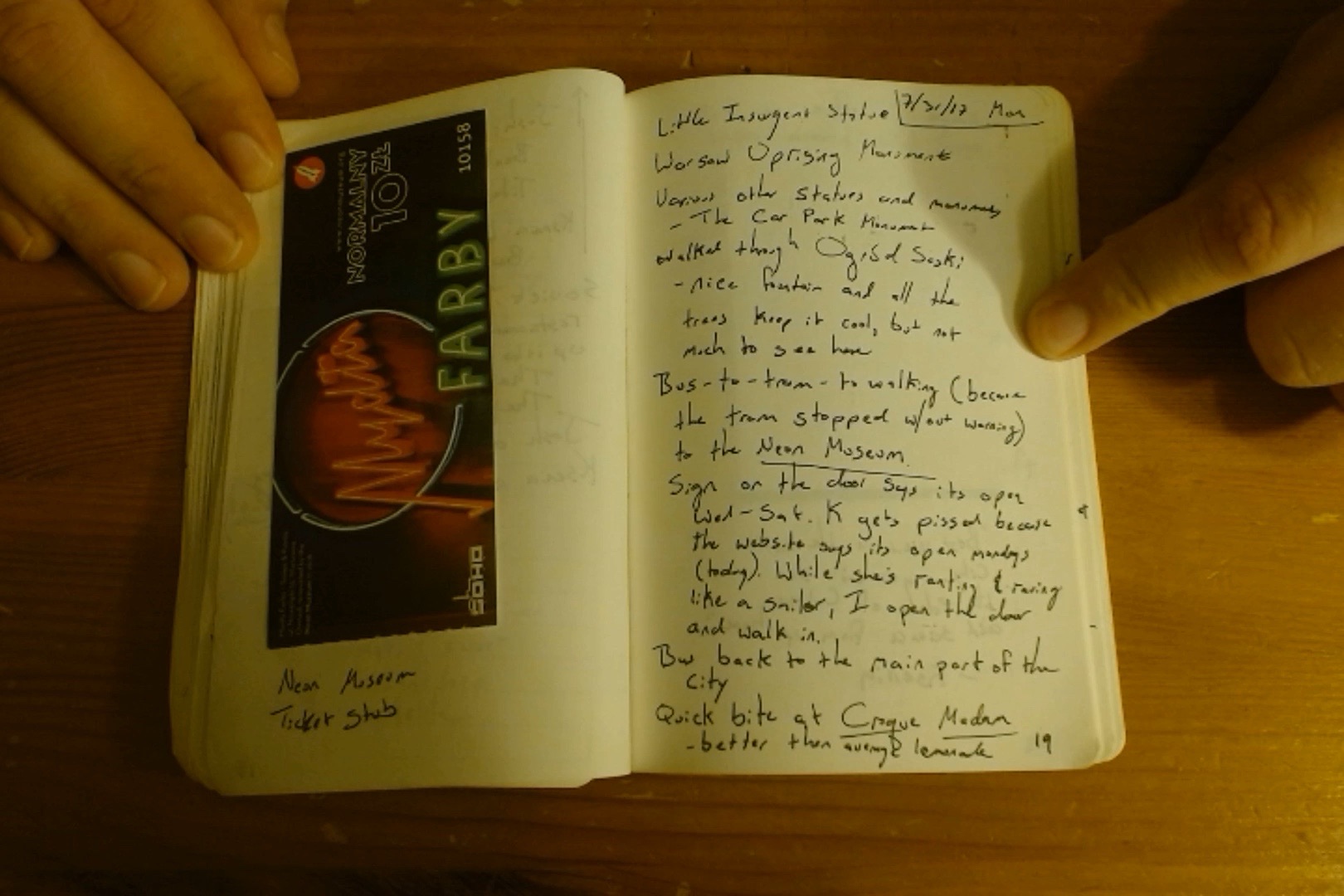
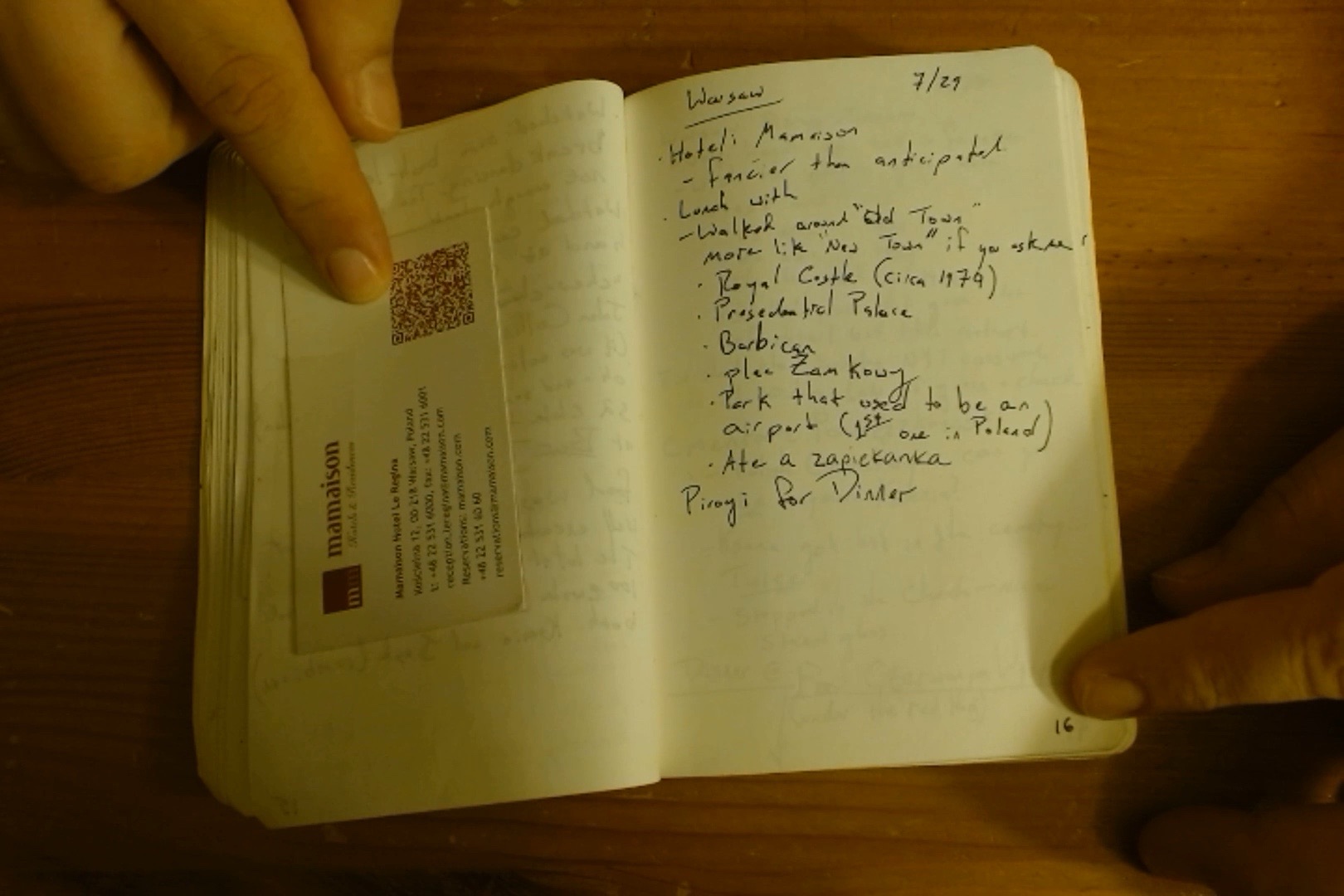
We passed the Warsaw Uprising monuments and wandered through Ogród Saski. The trees and fountain kept it cool, but there wasn’t much to see. Bus, tram, and a walk after the tram stopped without warning got us to the Neon Museum. The sign said it was open Wednesday through Saturday; the website said Monday. I tried the door anyway. No luck.

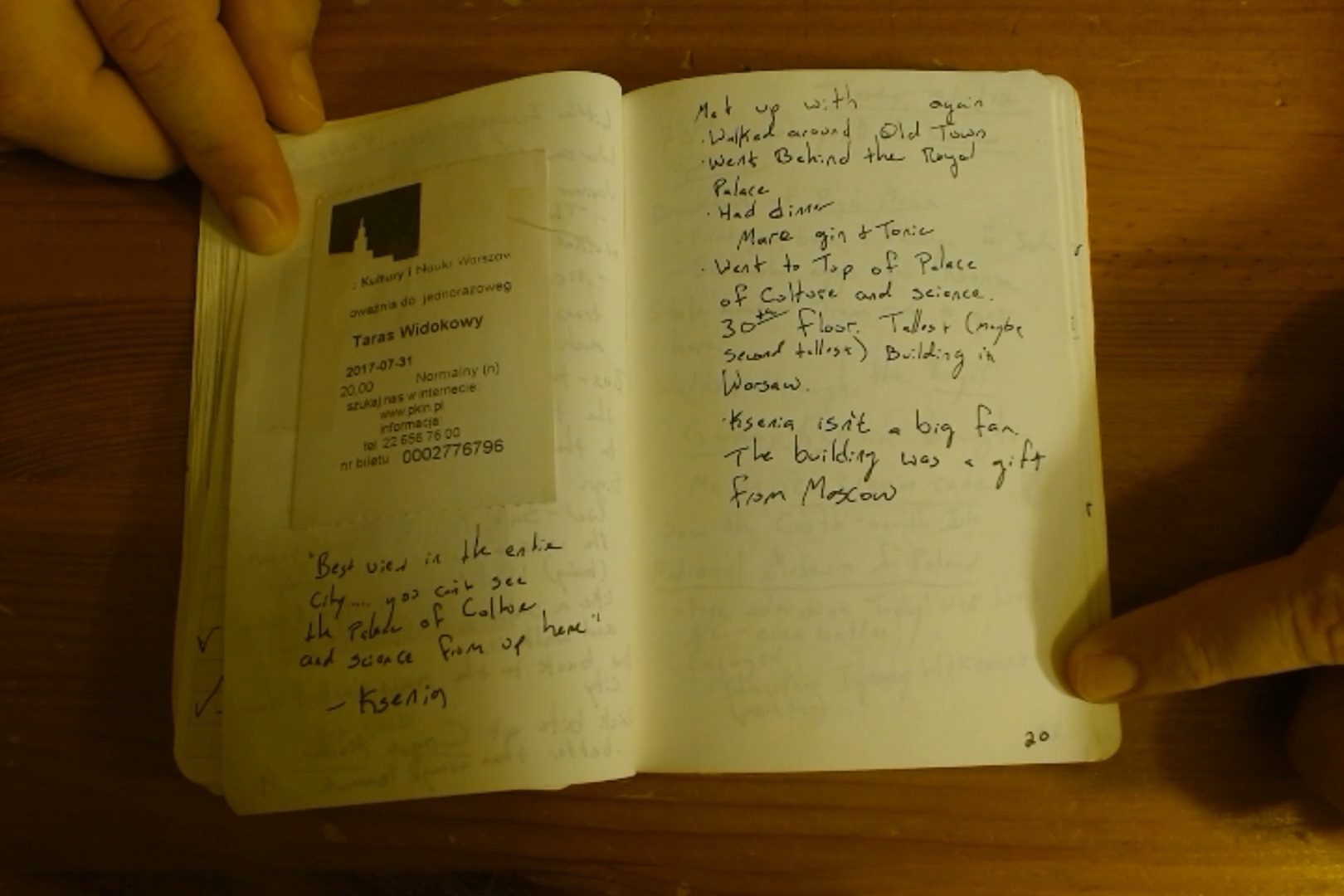
Back in the main part of the city, we had a quick bite at Croque Madame—better than average lemonade. We met up with friends, wandered Old Town and behind the Royal Palace, and had dinner and more gin and tonics. Then we went to the 30th-floor viewing terrace at the Palace of Culture and Science. Ksenia wasn’t a fan of the building, a gift from Moscow: “Best view in the entire city. You can’t see the Palace of Culture and Science from up here.”

Read the Poland trip summary.

From the Notebook

Poland 2017 notebook, page 19 Poland 2017 notebook, page 20

Travel, Food comments edit

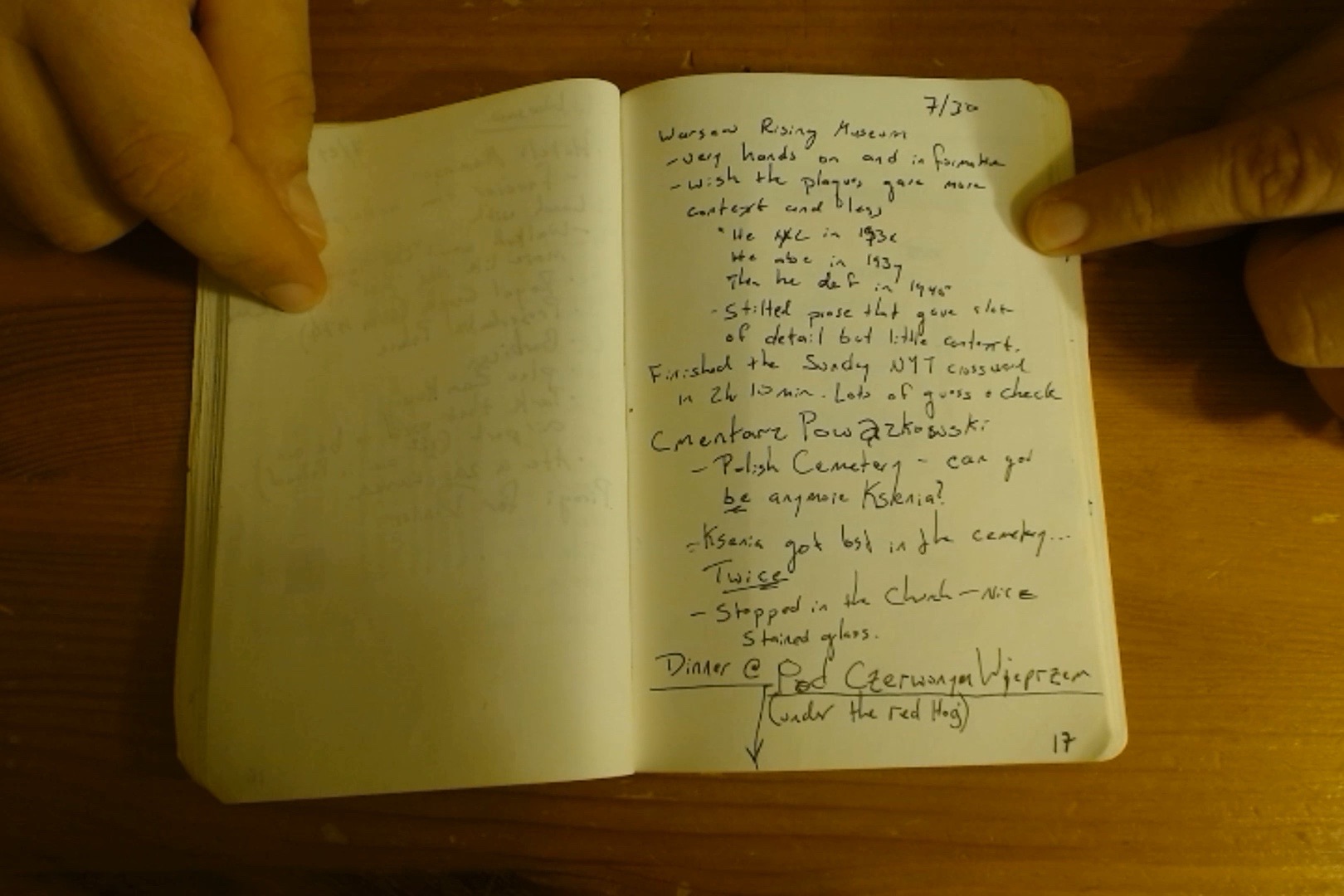
The Warsaw Rising Museum had so much information and so many hands-on exhibits that I wished the playing and the context had been more clearly separated. I finished the Sunday New York Times crossword in 2 hours 10 minutes. Lots of clues to check.

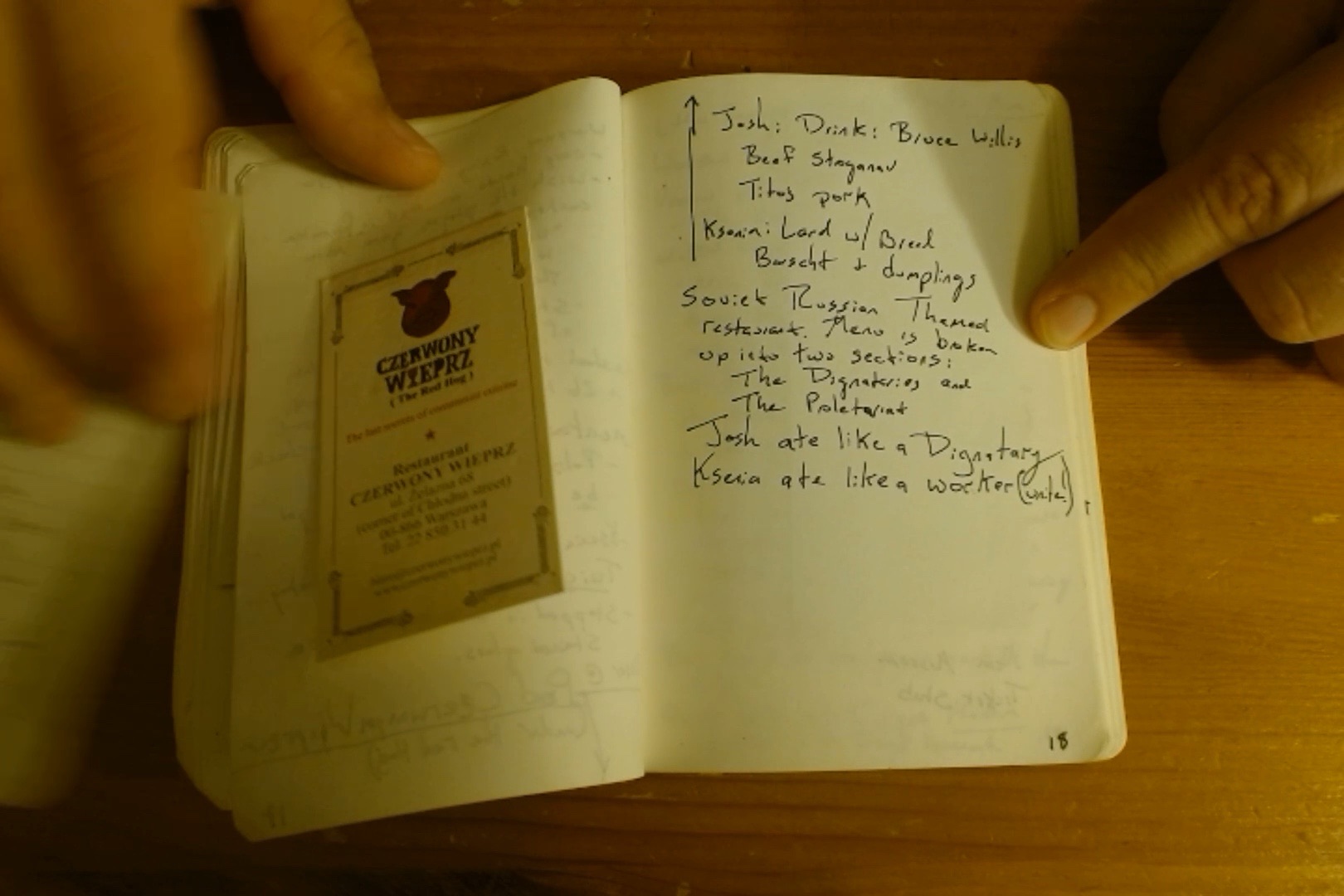
At Powązki Cemetery, Ksenia got lost twice. We stopped in a church with nice stained glass. Dinner was at Czerwony Wieprz, a Soviet/Russian-themed restaurant with menus for “the Dignitaries” and “the Proletariat.” I had a Bruce Willis drink, beef stroganoff, and Tito’s pork. Ksenia had lard with bread, borscht, and dumplings. I ate like a dignitary; Ksenia ate like a worker.

Read the Poland trip summary.

From the Notebook

Poland 2017 notebook, page 17 Poland 2017 notebook, page 18

Travel, Food comments edit

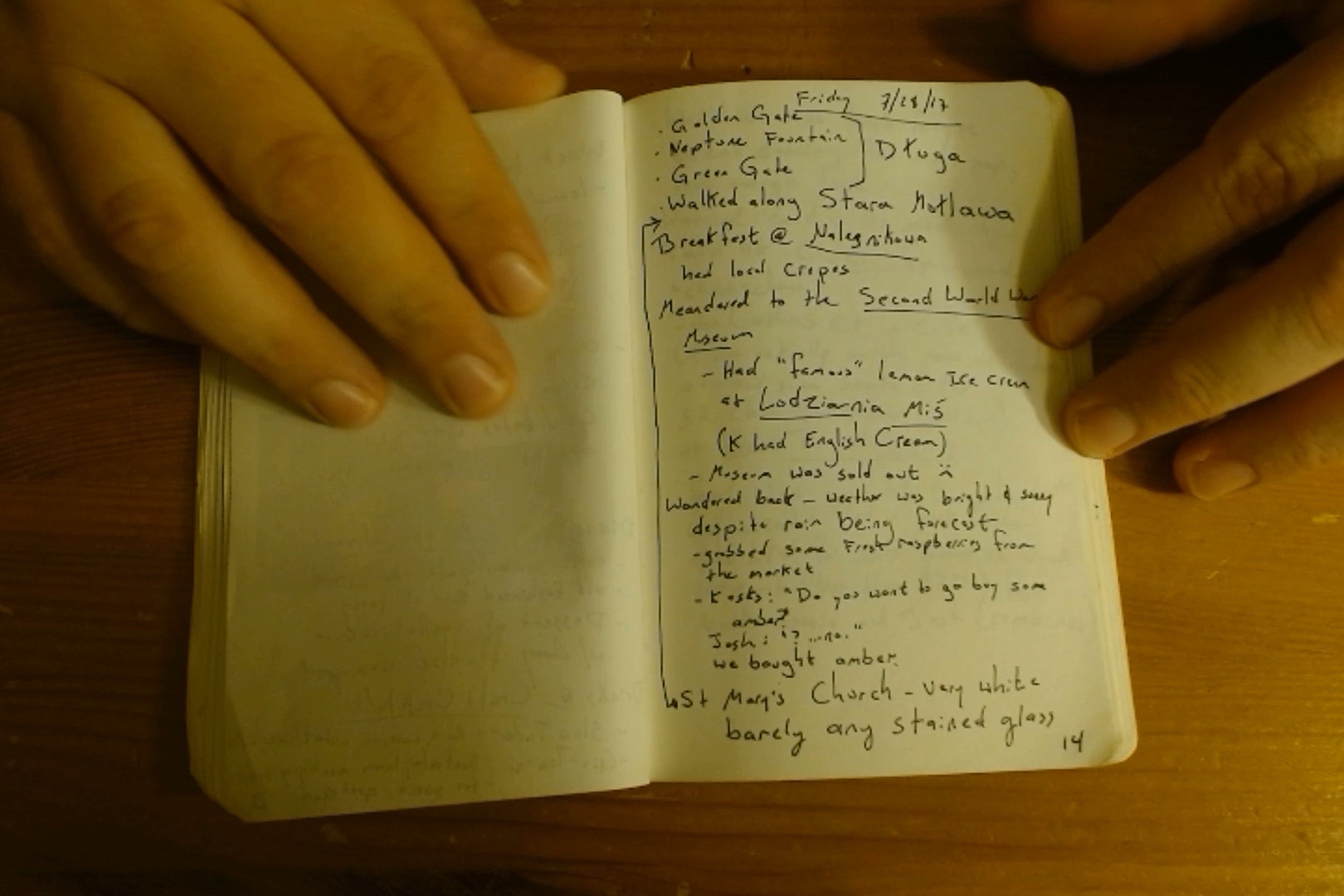
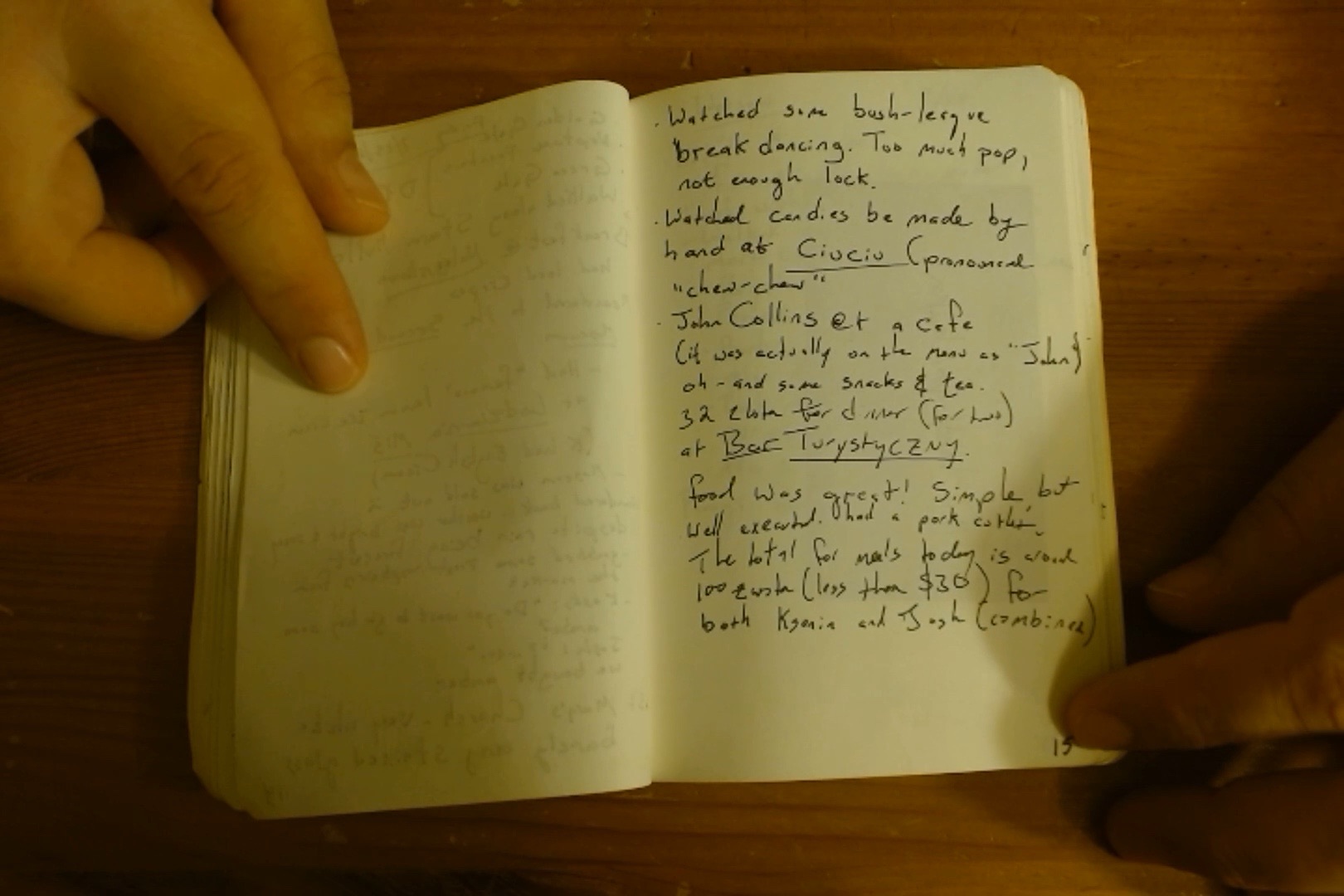
We walked Długa past the Golden Gate, Neptune’s Fountain, and Green Gate, then along the Motława. Breakfast was local crêpes at NaLeśnikowa. We made our way to the Museum of the Second World War and had “famous” lemon ice cream at Lodziarnia Miś. Ksenia got English cream; I think mine was sold out.

The weather was bright and sunny. Ksenia asked whether I wanted to buy amber. “I? No.” We bought amber. We also went into St. Mary’s Church: very white, with barely any stained glass.

We watched buskers breakdance to too much pop, watched candy being made by hand at Ciuciu, and stopped for a John Collins, snacks, and tea. Dinner at Bar Turystyczny cost 32 złoty for both of us. Simple food, well executed, like pork cutlets should be. The day’s meals came to around 100 złoty—less than $30 for the two of us.

Read the Poland trip summary.

From the Notebook

Poland 2017 notebook, page 14 Poland 2017 notebook, page 15

Travel, Food comments edit

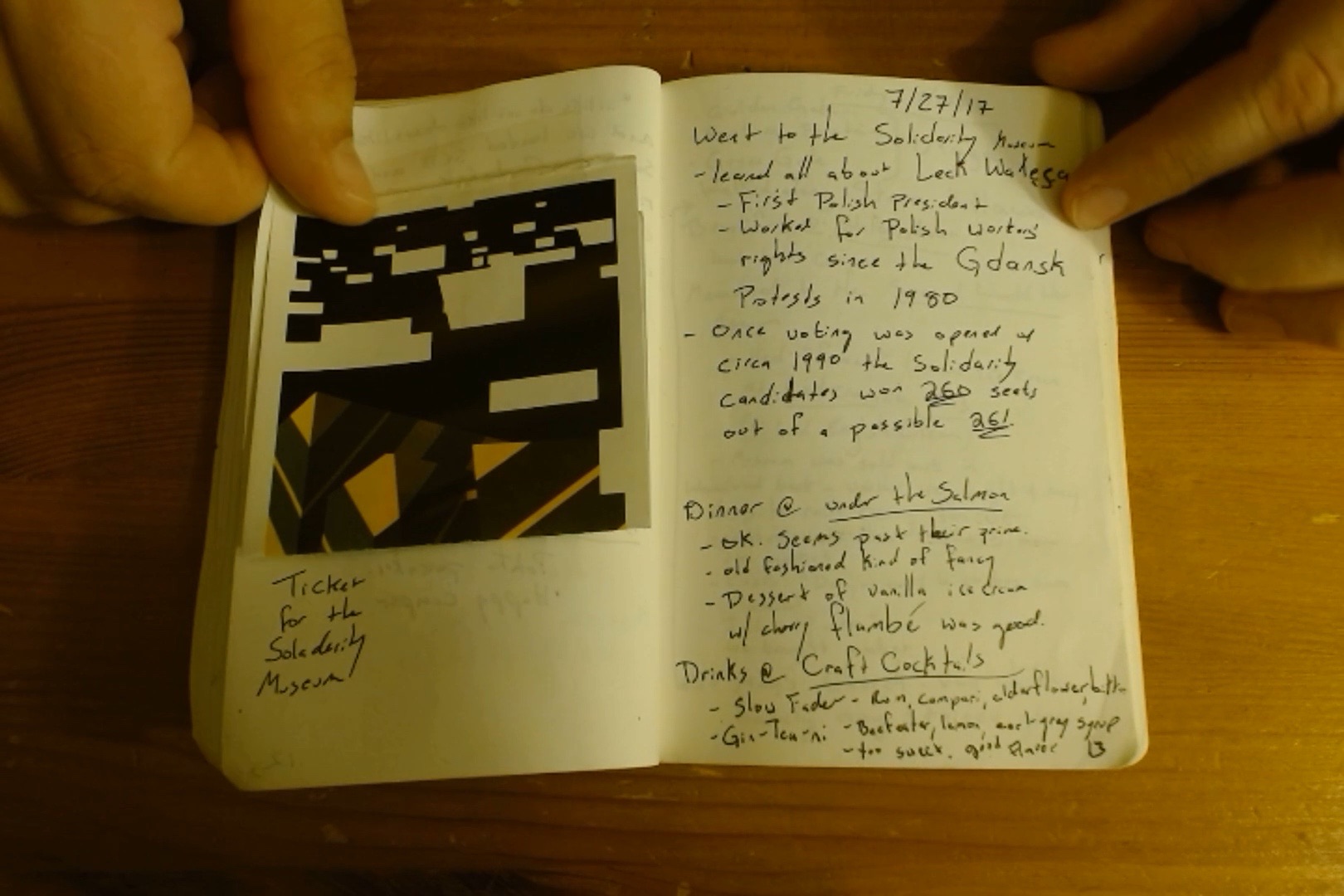
We went to the European Solidarity Centre and learned about Lech Wałęsa and the Solidarity movement. I wrote down that Solidarity candidates won 260 of 261 available seats when voting opened up around 1990.

Dinner at Pod Łososiem was okay, though it seemed past its prime. The old-fashioned place was fancy; vanilla ice cream with cherry flambé was good. We followed it with drinks at Craft Cocktails: a Slow Fader with rum, Campari, elderflower, and bitters, and a gin cocktail with Beefeater, lemon, and an egg-white foam. The second drink took too long and got warm.

Read the Poland trip summary.

From the Notebook

Poland 2017 notebook, page 13

Travel, Food comments edit

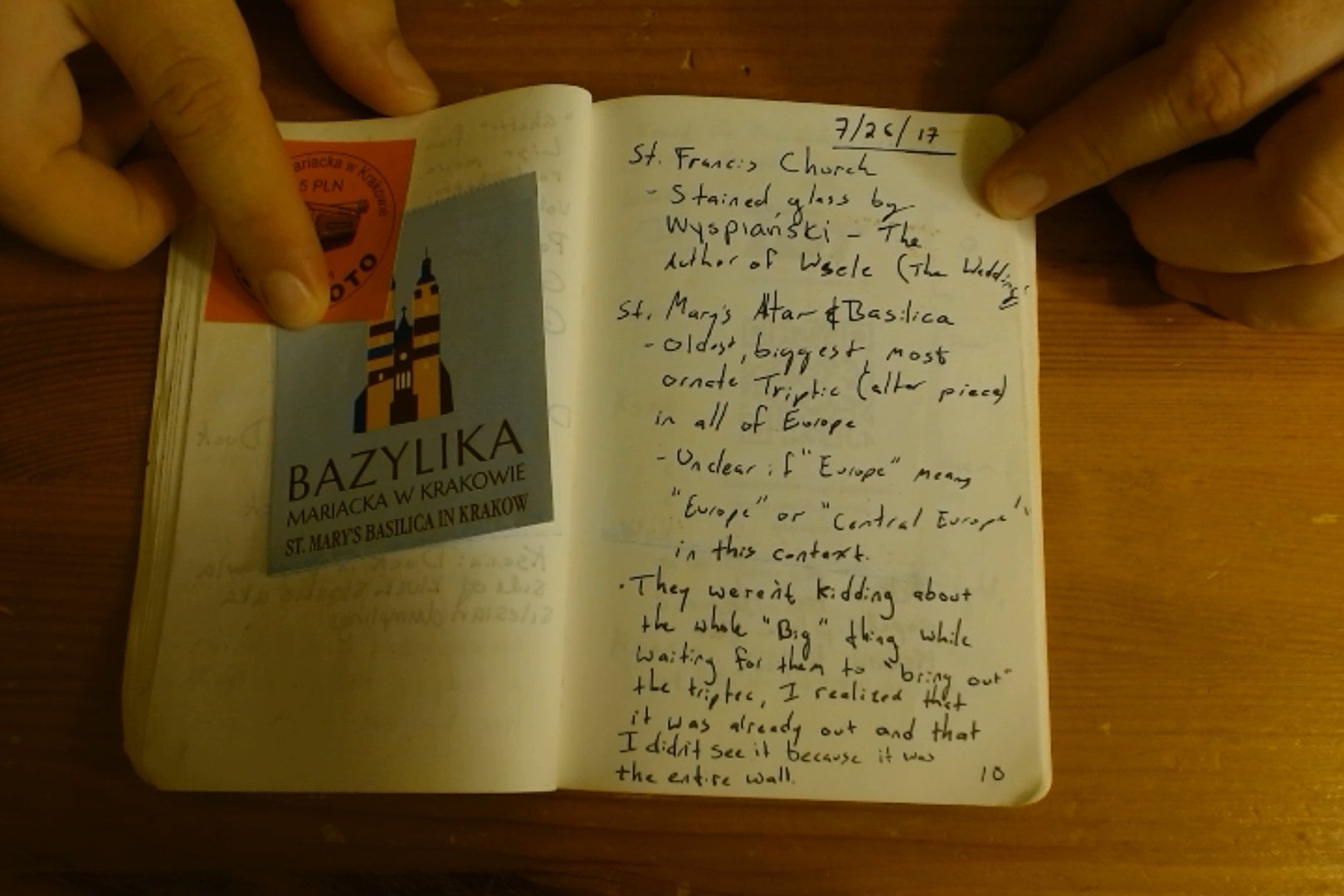
At St. Francis’s Church we saw stained glass by Stanisław Wyspiański. At St. Mary’s Basilica I somehow missed the giant altarpiece while waiting for someone to “bring it out.” It was already out. It took up the entire wall.

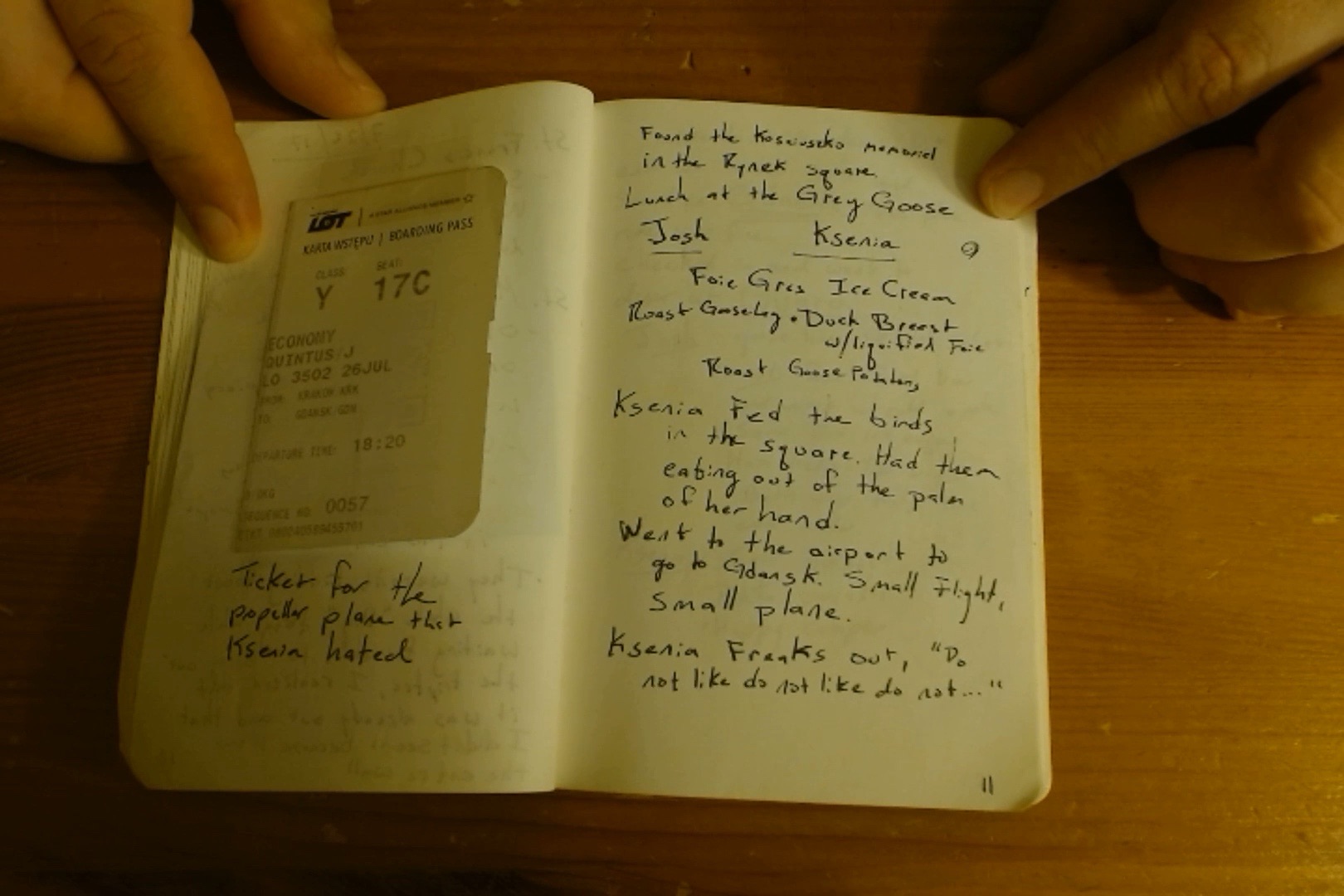
We found the Kościuszko memorial in the market square and had lunch at Szara Gęś (the Grey Goose). I had foie gras ice cream and roast goose; Ksenia had duck breast with foie gras and roast goose potatoes. She fed the birds in the square until they ate from her hand.

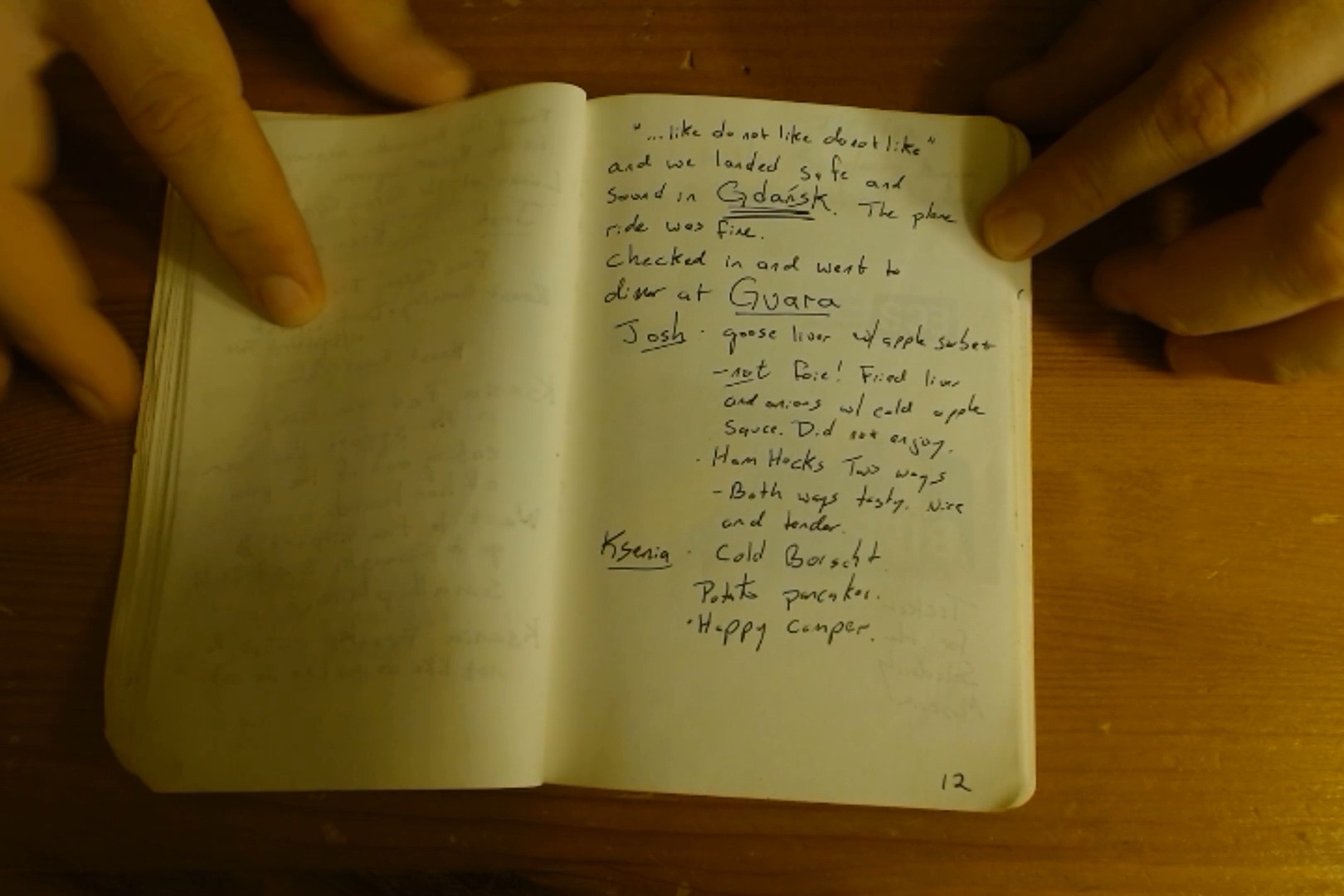
Then came a small flight to Gdańsk. Ksenia did not like the plane. We landed safely, checked in, and had dinner at Gvara. My goose liver with apple sauce was fried liver, not foie gras, and I didn’t enjoy it. The two-way ham hock was nice and tender. Ksenia had cold borscht and potato pancakes and was a happy camper.

Read the Poland trip summary.

From the Notebook

Poland 2017 notebook, page 10 Poland 2017 notebook, page 11 Poland 2017 notebook, page 12

Travel, Food comments edit

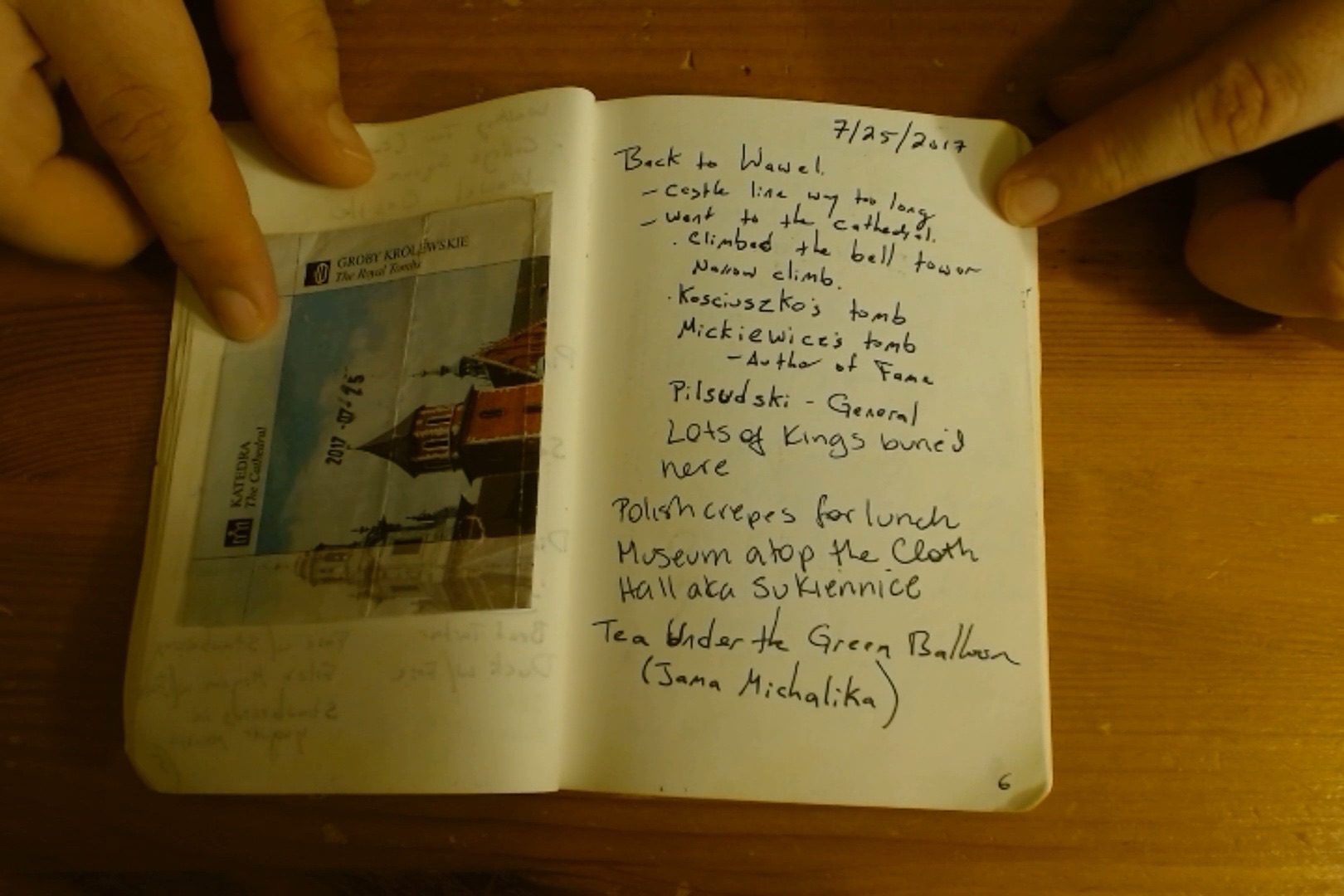
We went back to Wawel, but the castle line was too long, so we went into the cathedral instead. I climbed the bell tower—narrow climb—and saw the tombs of Kościuszko, Mickiewicz, Piłsudski, and a lot of Polish kings. Polish crêpes for lunch, the museum above the Cloth Hall, then tea at Jama Michalika, the home of the Green Balloon cabaret.

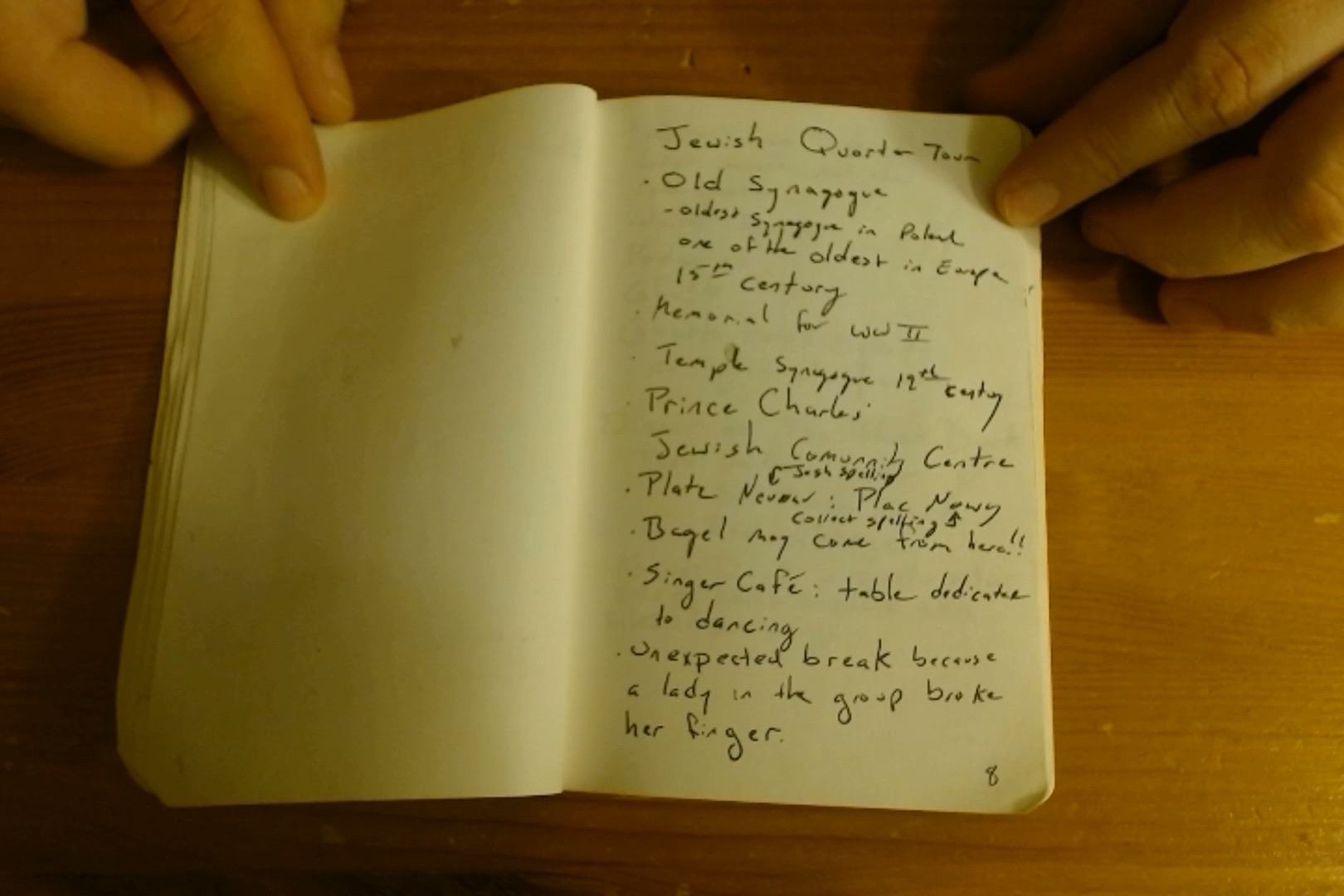
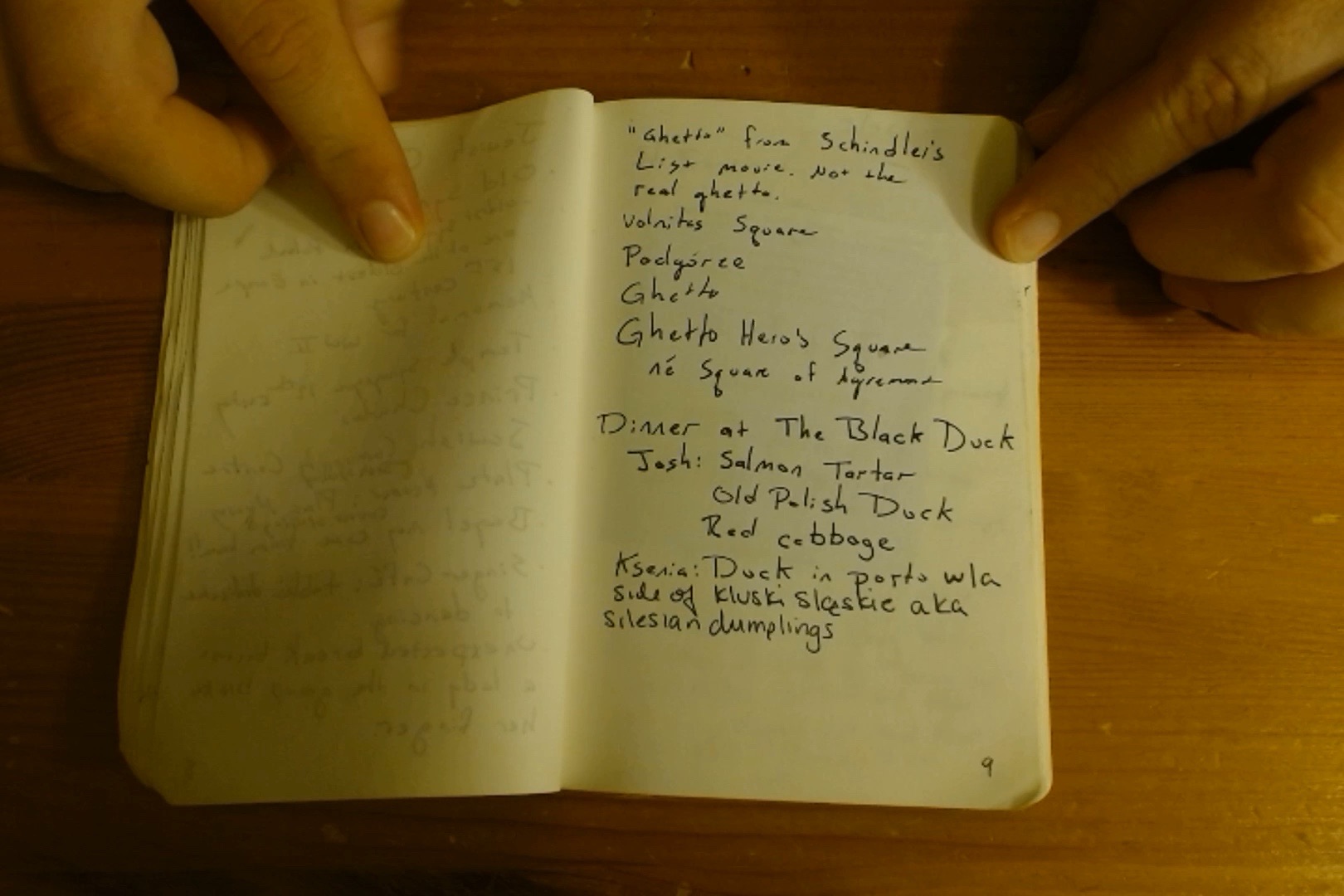
Our Jewish Quarter tour took us through the Old Synagogue, Temple Synagogue, and the Jewish Community Centre. We stopped at Singer Café, where a table was dedicated to dancing. One of the women in the group broke her finger, which was not on the itinerary. We also went to Podgórze and Ghetto Heroes Square. The “ghetto” from Schindler’s List wasn’t the real ghetto.

At The Black Duck I had salmon tartare and Old Polish duck with red cabbage. Ksenia had duck in port with Silesian dumplings.

Read the Poland trip summary.

From the Notebook

Poland 2017 notebook, page 6 Poland 2017 notebook, page 8 Poland 2017 notebook, page 9

Travel, Food comments edit

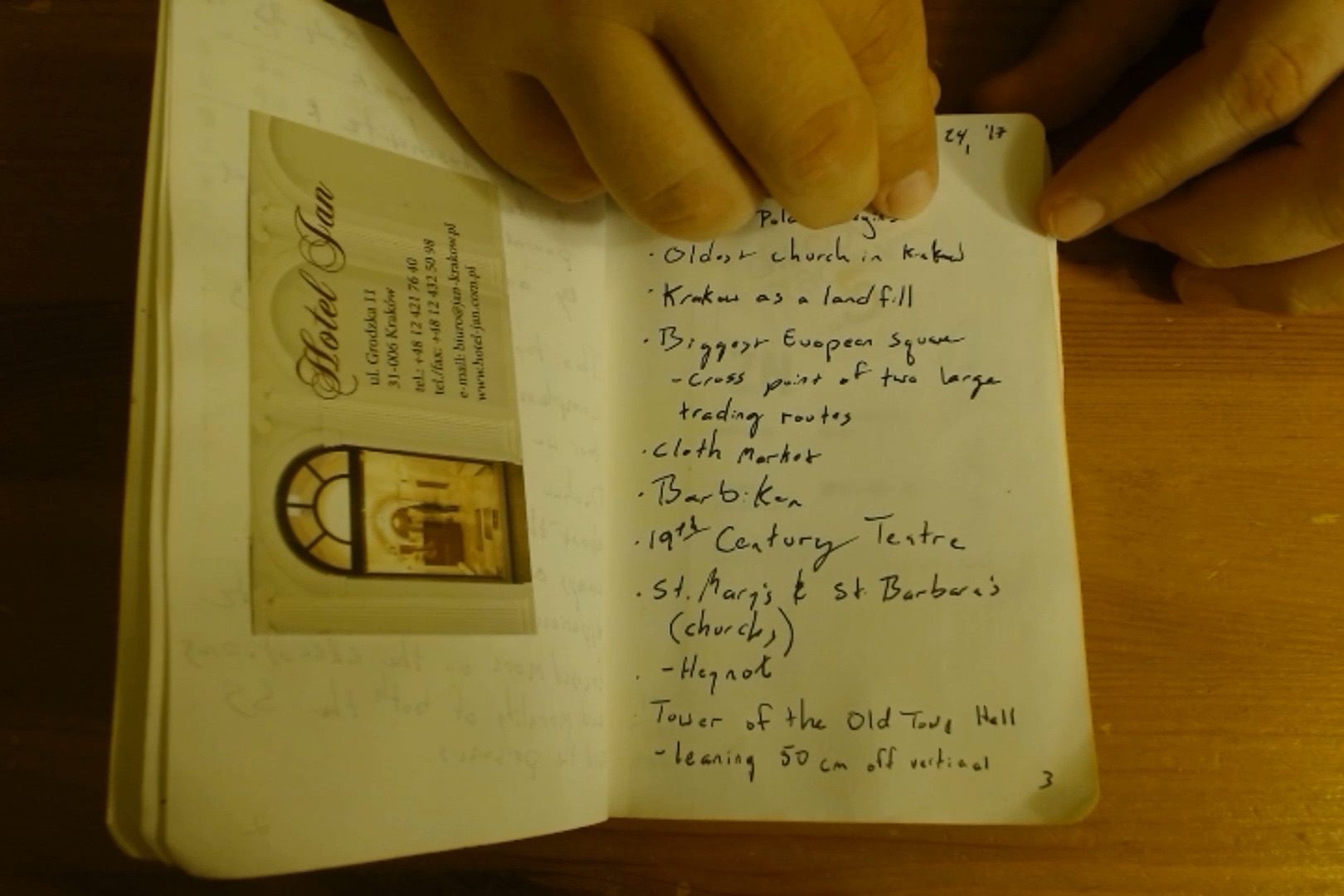
We took a walking tour of Kraków: the main square, the Cloth Hall, the Barbican, St. Mary’s and St. Barbara’s churches, the old town hall tower, Collegium Maius, and Wawel. The tower is apparently leaning about 50 centimeters off vertical. The square is huge; our guide traced it to the meeting of two trading routes.

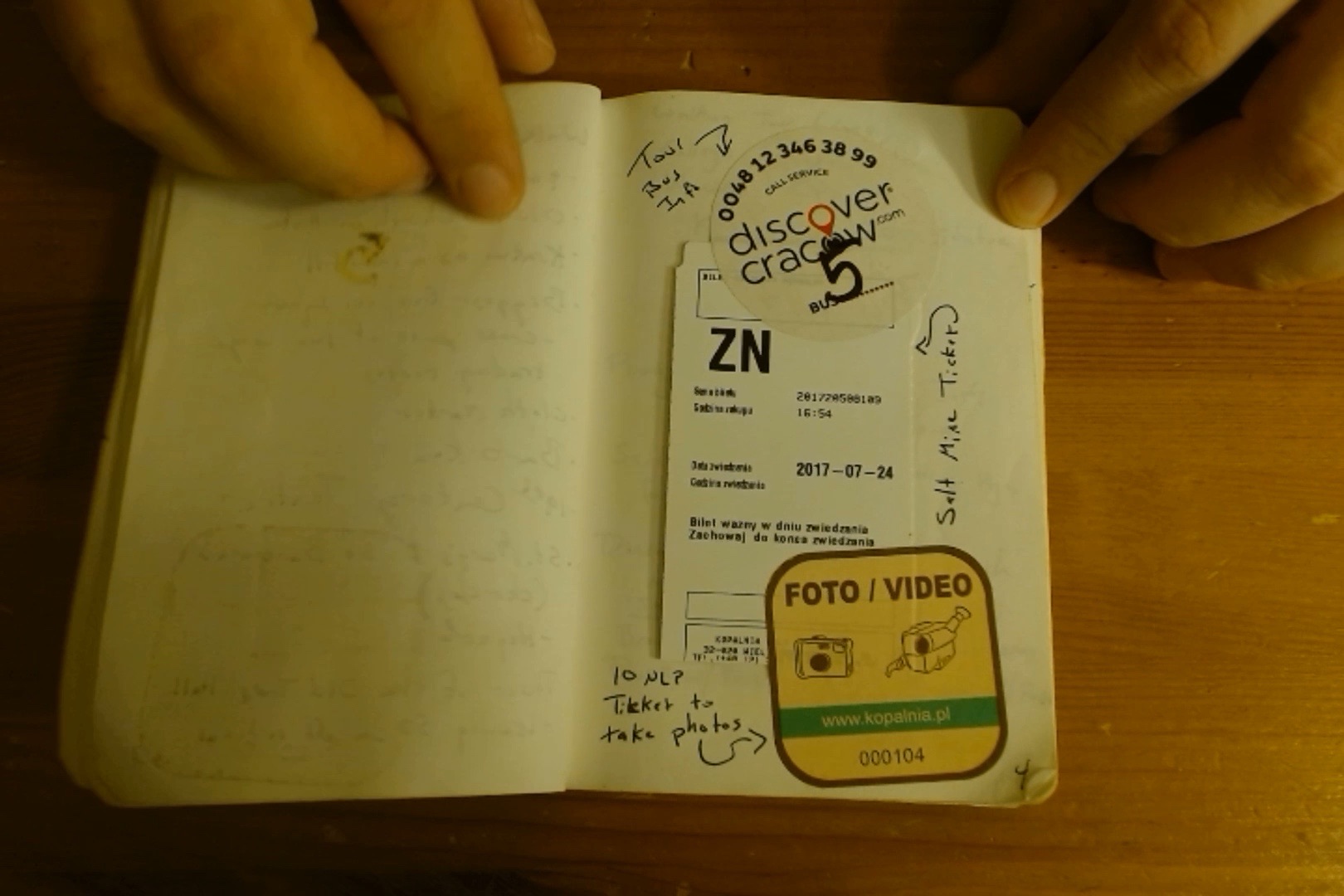
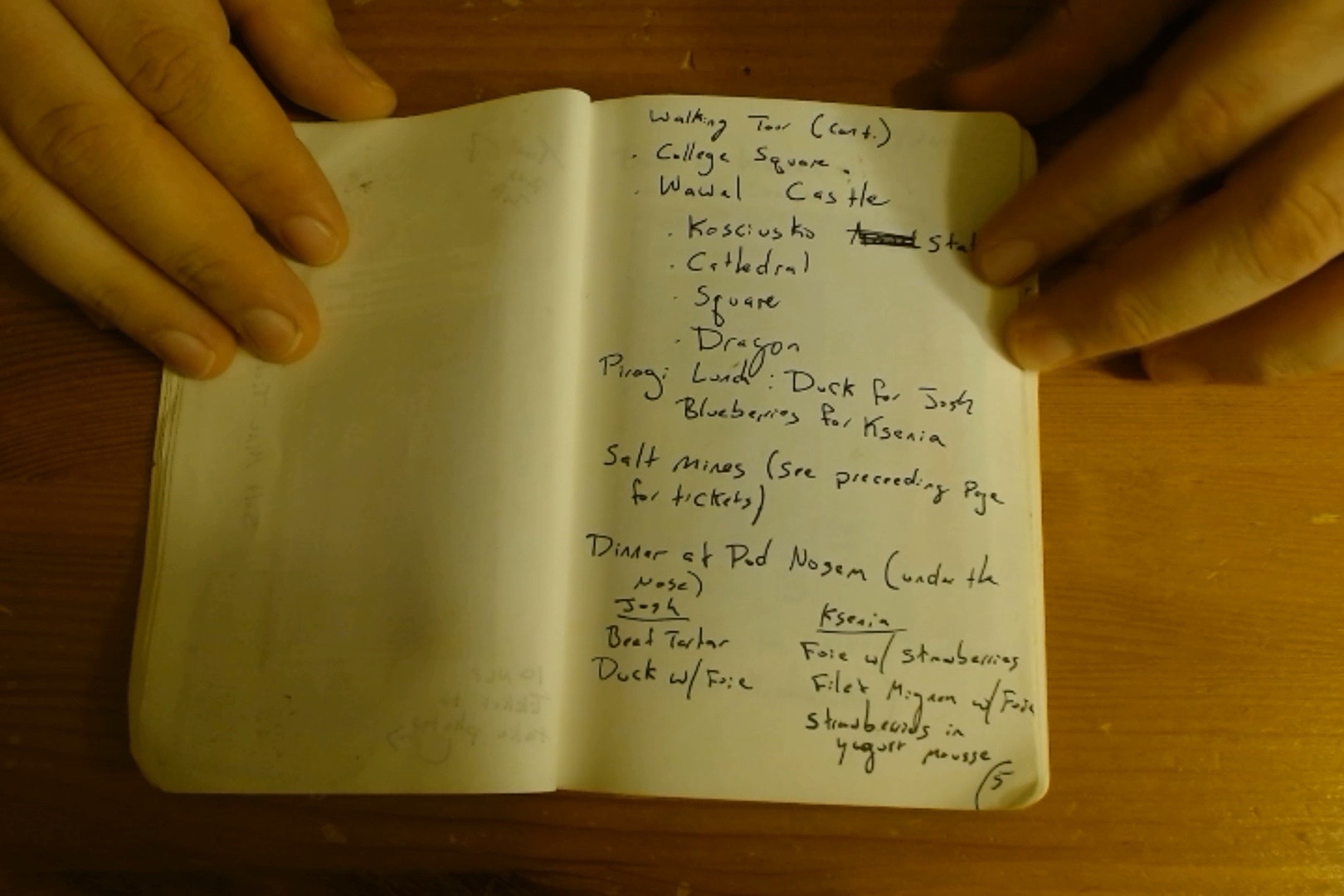
I found duck pierogi; Ksenia found blueberries. Then we went underground at the Wieliczka Salt Mine.

Dinner at Pod Nosem—“under the nose”—was beef tartare and duck with foie gras for me. Ksenia had foie gras with strawberries and filet mignon with foie gras, plus strawberries in yogurt mousse.

Read the Poland trip summary.

From the Notebook

Poland 2017 notebook, page 3 Poland 2017 notebook, page 4 Poland 2017 notebook, page 5

Travel, Food comments edit

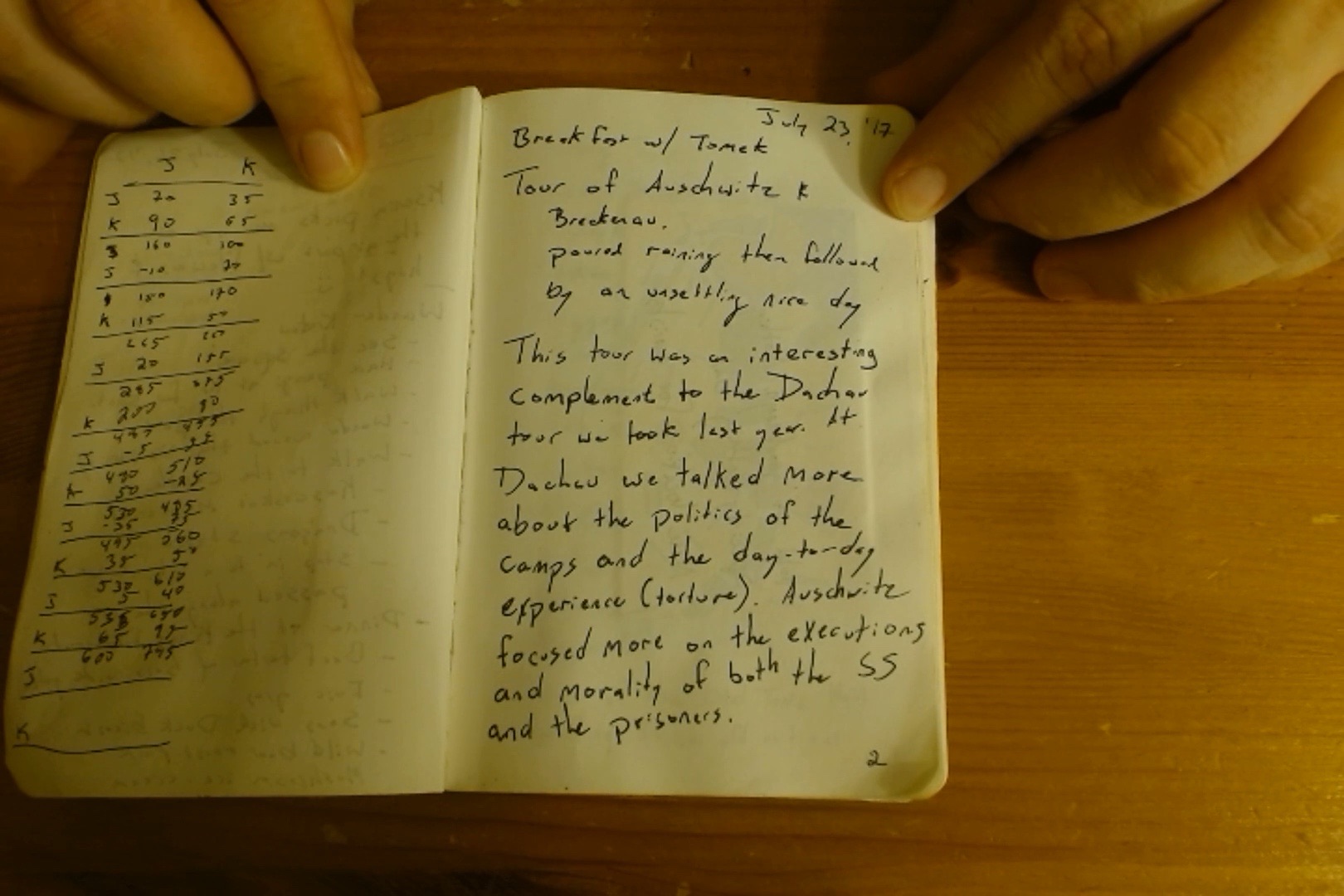
Breakfast with Tomek, then a tour of Auschwitz and Birkenau. It poured rain, then turned into an unsettlingly nice day.

The tour was an interesting complement to the Dachau tour we took last year. At Dachau we talked more about camp politics and the prisoners’ day-to-day experience. Auschwitz focused more on the executions and the morality of both the SS and the prisoners. Not an easy day.

Read the Poland trip summary.

From the Notebook

Poland 2017 notebook, page 2

Travel, Food comments edit

Poland, Summer 2017

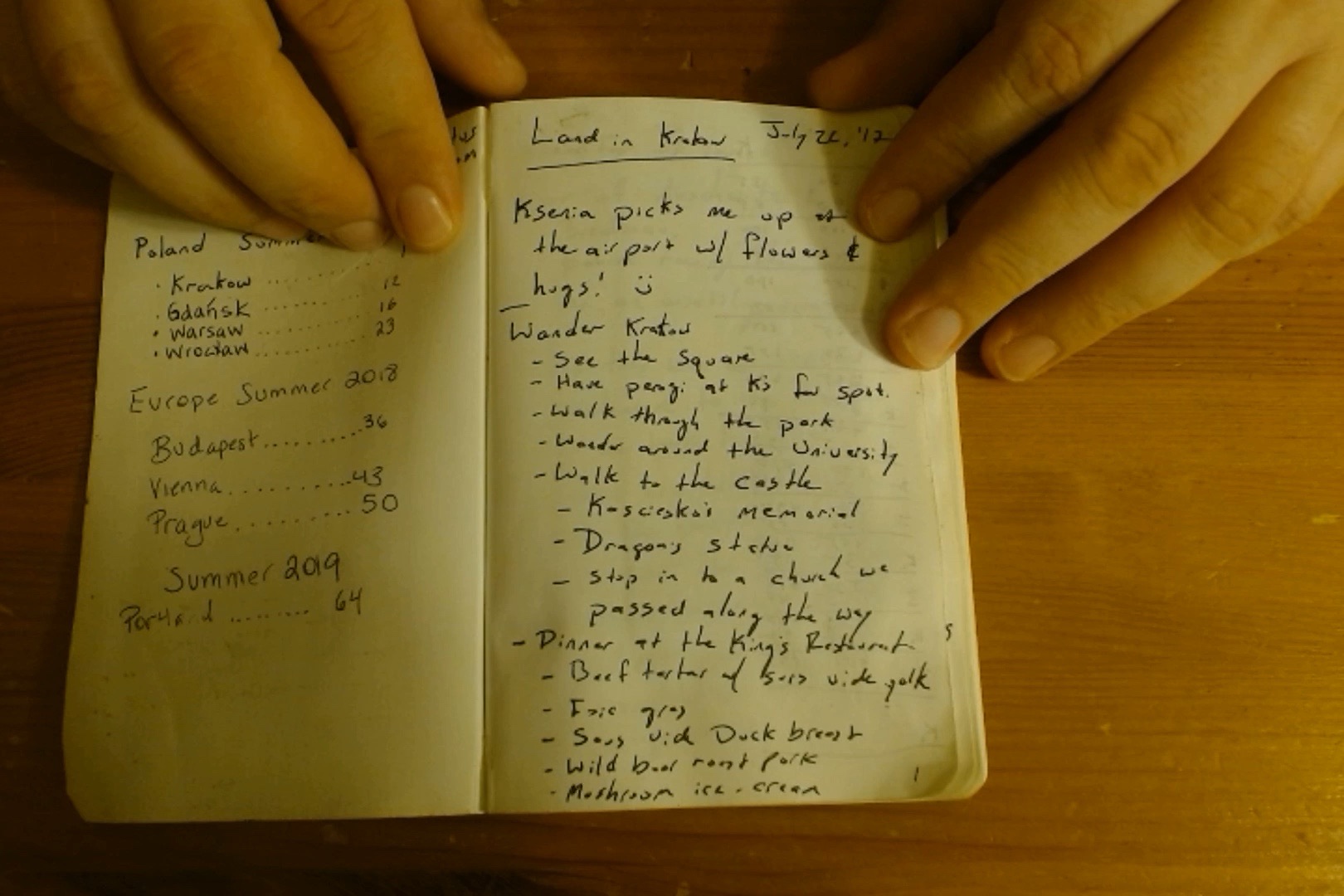
Ksenia picked me up at the Kraków airport with flowers and hugs. We wandered the square, found a place for pierogi, walked through the park and around the university, and made our way to Wawel. I saw the Kościuszko memorial and the dragon statue, and we ducked into a church on the way.

Dinner was at the King’s Restaurant: beef tartare, foie gras, sous-vide duck breast, wild boar roast pork, and mushroom ice cream. Quite a start.

Read the Poland trip summary.

From the Notebook

Poland 2017 notebook, page 1

vim comments edit

I’ve been using Vim for close to 15 years now and it always amazes me. I needed a quick and easy way to encrypt some files on a thumb drive when going from one computer to another. After about 5 seconds of googling I see that as always, vim’s got my back.

First off, you can optionally select your encryption scheme by doing :setlocal cm=blowfish2. There are other options, but that’s the strongest encryption available. Next all you need to do is set the password by typing: :X (note that it is a capital X). You’ll be prompted for the password. After that just close vim as normal. You can cat out your file on the terminal to double check that it’s encrypted.

When you repopen the file in vim, you’ll be prompted to enter the password to decrypt the data.

If you want to save the decrypted file, just clear out the key by doing :set key= and then save the file.

Background

Okay, so I don’t really know why I’d use this, but I just came across Ninject.Extensions.Interception. Basically it allows you to intercept an arbitrary method call and run code before and after the call. Even replace the method entirely.

You could use this to achieve many things you would use Aspect Oriented Programming to do. Post Sharp has a great breakdown on what those use cases are and why it’s a valid approach to solving certain problems.

The canonical use case for this is the ability to easily add logging when you enter and exit a method.

For example, the following code would log all calls to the SomeSuperImportantMehod

[LogAllMethods]
public class CanonicalLogging
{
  public virtual int SomeSuperImportantMehod(string input, int maxItems)
  {
    return CalcualteReallyImportantThing(input, maxItems);
  }
}

And here’s an example of what the output could be

2017-05-05 13:45:54.64723 CanonicalLogging.SomeSuperImportantMehod called with parameters:  {input:  "Hello World", maxItems: 34 }
2017-05-05 13:56:56.94949 CanonicalLogging.SomeSuperImportantMehod returned "42" after running for 11:02:30226

Walkthrough

For the example I’m going to build an implementation of the Dispose Pattern with a base class that will handle all of the actual disposing logic. I’ll use a custom interceptor to ensure that once my objec thas been disposed all future calls to it will throw an ObjectDisposedException.

To get started you first need to be using Ninject. I’m going to assume you have a bit of a background with Ninject. Just in case you don’t, the quick version is that it’s a .Net IoC container. Basically that means that after doing a little configuration you can ask it for an instance of any type you want and it will give it to you, creating it and its dependencies if it needs to.

Another thing to be aware of is that there are two options, either use LinFu or CastleCore for the proxy generation. As far as I can tell, this decision doesn’t really impact much. Just pick whichever framework you like, or one at random. I already use CastleCore in other projects (the Ninject factory extension depends on it), so I’m going with that one.

Install-Package Ninject.Extensions.Interception.DynamicProxy

ADisposable

Next I’ll create the base ADisposable that all of my custom disposable objects will inherit from.

    [Disposable]
    public abstract class ADisposable : IDisposable
    {
        public ADisposable()
        {
            IsDisposed = false;
        }

        ~ADisposable()
        {
            Dispose(false);
        }

        internal bool IsDisposed { get; private set; }

        public void Dispose()
        {
            Dispose(true);
            GC.SuppressFinalize(this);
        }

        protected abstract void OnDispose();

        private void Dispose(bool disposing)
        {
            if (IsDisposed) return;

            if (disposing)
            {
                OnDispose();
            }

            IsDisposed = true;
        }
    }

There two things worth pointing out here. First, the internal IsDisposed property. This will be used by our interceptor later to determine if the object has been disposed. The other thing worth noting is the Disposable attribute. That’s a custom attribute I defined. It inherits from Ninject.Extensions.Interception.Attributes.InterceptAttribute. This is the first step into using interceptors, so let’s take a look.

DisposableAttribute

using Ninject;
using Ninject.Extensions.Interception;
using Ninject.Extensions.Interception.Attributes;
using Ninject.Extensions.Interception.Request;
using System;

namespace Interceptors
{
    [AttributeUsage(AttributeTargets.Class)]
    public class DisposableAttribute : InterceptAttribute
    {
        public override IInterceptor CreateInterceptor(IProxyRequest request)
        {
            return request.Kernel.Get<DisposableInterceptor>();
        }
    }
}

There’s only one method that we have to worry about CreateInterceptor. This just lets the system know what interceptor to use when creating the implementation of ADisposable. You can see here that I added the AttributeUsage to specifically target only classes. Be default InterceptAttributes can be put on anything, although they really only make sense on method (including properties) and class definitions. When the attribute is placed on the class, it impacts all of the methods. In fact there is a neat DoNotIntercept attribute that you can use to exclude certain methods from the class wide interceptor.

In my example, I used the request to get an instance of the Kernel so I could resolve the interceptor I wanted. That was mostly just to illustrate that you can get a hold of the kernel. In this instance, I could have just as easily newed up the DisposableInterceptor. Speaking of which, DisposableInterceptor is where the most interesting code is. We’ll look at that next.

DisposableInterceptor

using Ninject.Extensions.Interception;
using System;

namespace Interceptors
{
    public class DisposableInterceptor : SimpleInterceptor
    {
        protected override void BeforeInvoke(IInvocation invocation)
        {
            base.BeforeInvoke(invocation);

            var disposable = invocation.Request.Target as ADisposable;

            if (disposable != null && invocation.Request.Method.IsPublic)
            {
                if (disposable.IsDisposed)
                {
                    string methodName = invocation.Request.Method.Name;
                    throw new ObjectDisposedException(disposable.GetType().Name, $"{methodName} called after object was disposed");
                }
            }
        }
    }
}

It inherits from SimpleInterceptor and overrides BeforeInvoke. As you may guess, there’s an AfterInvoke as well. If you wanted to, you could set the return value of the method by setting invocation.ReturnValue in BeforeInvoke. Or in AfterInvoke you could check to see if it’s within certain limits.

Anyway, in this example all I care about is overriding BeforeInvoke to check if

  1. The instance being invoked is an instance of ADisposable
  2. The method being called is public (no need to worry about private methods being called since they’d have to be called from public ones to begin with)
  3. If the instance had already been disposed.

In order to do all of those things, I just need to inspect sub-properties of the passed in instance of IInvocation. If all of those things are true, then we just throw an exception.

Now that we see the interception code is straight forward, let’s put it all together so that we can use it.

Sample Service

public interface ISomeService : IDisposable
{
    void SomeMethod(string msg);
}

public class MyService : ADisposable, ISomeService
{
    public void SomeMethod(string msg)
    {
        Console.WriteLine(msg);
    }

    protected override void OnDispose()
    {
        Console.WriteLine("Disposing MyService");
    }
}

The first thing to look at is the sample service interface and implementation. ISomeService is just a simple interface that inherits from IDisposable and has a single method to implement. MyService inherits from ADisposable and ISomeService and pretty much does the minimum it needs to do to implement them.

Notice though that neither of them are aware of either Ninject or any of the interceptors. They are bog standard C# classes.

Resolving an Interface

private static void TestResolvingInterface()
{
    Console.WriteLine("Testing resolving an Interface from the Ninject Kernel");
    using (var kernel = new StandardKernel())
    {
        kernel.Bind<ISomeService>().To<MyService>();

        ISomeService service = kernel.Get<ISomeService>();

        TestService(service);
    }
}

private static void TestService(ISomeService service)
{
    Console.WriteLine("    " + service.GetType().Name); // Prints out "ISomeServiceProxy"
    service.SomeMethod("    Hello World");
    service.Dispose();

    try
    {
        service.SomeMethod("    This call should fail");
    }
    catch (ObjectDisposedException odex)
    {
        Console.WriteLine(odex.Message);
    }
}

In the first method, TestResolvingInterface, we do some very standard Ninject setup. Create a standard kernel, add some bindings, and then resolve our interface. Again, none of this is even aware of the interceptors. Ninject picked up on it from the attribute and that was enough.

The output for this is:

Testing resolving an Interface from the Ninject Kernel
    ISomeServiceProxy
    Hello World
Disposing MyService
SomeMethod called after object was disposed
Object name: 'MyService'.

You’ll notice that service is an instance of ISomeServiceProxy, not MyService. Ninject wrapped our instance of MyService, adding the extra functionality to the proxy without actually impacting our class.

You’ll also see that the second call to SomeMethod does indeed fail with an ObjectDisposedException.

Resolving a Concrete Class

Now that worked all well and good. But what if we resolved just a class instead of an interface? Well that’s where this starts to break down as we’ll see in the code below.

private static void TestResolvingConcreteClass()
{
    Console.WriteLine("Testing resolving a Concrete Class from the Ninject Kernel");
    using (var kernel = new StandardKernel())

    {
        MyService service = kernel.Get<MyService>();
        TestService(service);
    }
}

private static void TestService(ISomeService service)
{
    Console.WriteLine("    " + service.GetType().Name); // Prints out "MyServiceProxy"
    service.SomeMethod("    Hello World");
    service.Dispose();

    try
    {
        service.SomeMethod("    This call should fail");
    }
    catch (ObjectDisposedException odex)
    {
        Console.WriteLine(odex.Message);
    }
}

So now we’re resolving a MyService directly and passing it to the same test function as the previous example. Let’s look at the output.

Testing resolving a Concrete Class from the Ninject Kernel
    MyServiceProxy
    Hello World
Disposing MyService
    This call should fail

We’re getting a proxy wrapping our class again (MyServiceProxy), which is a good sign, but then we see that the second call to SomeMethod actually succeeds. Why is this?

This is probably the biggest caveat in the entire thing. The interceptors can only impact virtual methods. Interface methods are by nature virtual so they are no problem. But when it comes to concrete classes, unless the method is explicislty marked as abstract or virtual it can’t touch them. As I mentioned above, Ninject is dynamically creating an implementation of the requested object with custom implementations of all the methods. If MyService had been sealed, Ninject would have thrown a TypeLoadException when it was resolved because it couldn’t subclass the type.

Summary

As mentioned above, the major caveat is that it only works with virtual methods. If you always use interfaces, then you will be just fine, but if you don’t the interceptors will silently fail to be called.

Other than that, this is a pretty easy to use tool that can provide a lot of power. Another obvious use case for this is automating INotifyPropertyChanged. It’s so obvious that it comes premade. Just check out the NotifyOfChanges attribute.

Jekyll, update comments edit

This is my first post on my new blogging engine. I’m using GitHub Pages now. So far I really like it. It’s nice and easy. I have been a big fan of markdown for some time now. Rich text that I can easily create in vim? Yes please! Creating templates for pages and content that I can easily create by adding structured data files to a folder? Yes please!

Travel, Food comments edit

Barcelona gave us plenty of reasons to keep eating: Iberian ham, foie gras, croquettes, tomato bread, and gin and tonics. The Devour Barcelona food tour and our two meals at La Pubilla were my food highlights. We spent the rest of the trip trying to fit Gaudí’s buildings, museums, and still more meals between them.

Where we ate and drank

Barcelona

Place My rating What I thought
Praktik Bakery ★★★★★ The bakery downstairs made breakfasts easy. Its bread and pastries were excellent.
Cervecería Catalana ★★★☆☆ Good tapas, especially the filet with foie, though the meal as a whole was good rather than great.
La Pepita ★★★★★ So good we went twice. Ksenia still talks about the foie gras with white chocolate and hazelnut.
Bormuth — Steak with foie and eggplant spread on tomato bread.
La Pubilla ★★★★★ My favorite restaurant of the trip. We came back for a second dinner, were welcomed like old friends, and still found more dishes to love. Best croquettes we had.
Alta Taberna Paco Meralgo — Another tapas stop during the trip.
El Nou Pi Antic — Ham toast, lamb ribs, Estrella, and crema catalana after a long walk through the Gothic Quarter.
Bar Mut — Cava, steak with foie, mussels, and potatoes with egg yolk and shrimp.
Tapeo del Born ★★★★☆ A little touristy, but still good. Ksenia liked it more than I did.
Elephanta — A gin-and-tonic flight in Gràcia.
Bobby Gin — A serious last-night gin-and-tonic stop with a huge selection.
La Boqueria — Sandwiches, charcuterie cones, and fresh juice in the market.

The Devour Barcelona food tour was ★★★★★. We stopped for sausage on tomato bread and cava at Can Tosca; olives at Conserves Glòria; ham at Fàbregas; cheese and jams at La Trobada del Gourmet; olive oil at Oli Sal; tomato bread and croquettes at L’Anxoveta; pastries at Pastisseria Príncep; vermouth, pickled anchovies, and sausage at Bodega Cal Pep; prepared food at La Botigueta del Bon Menjar; and cremat at Pastisseria Ideal. The small group made the tour even better.

We also had an enormous dinner at a place I didn’t name. The waiter kept thinking we were done ordering; we weren’t. One lunch near the Sagrada Família was a miss: slow service and microwaved food that was still cold.

Where we stayed

Hotel Praktik Bakery put us above a bakery with some of the best bread and pastries we found in the city. The location and rain showers were great too.

What we saw

The Sagrada Família was my favorite part of Barcelona that I couldn’t eat or drink. The stained-glass light changed every time I looked. Casa Batlló felt like an underwater fairy tale, and Park Güell was gorgeous even with the crowds. We also visited Palau Güell, the Picasso Museum, and Sant Pau. MACBA wasn’t for us.

I wrote a separate Barcelona guide after the trip, with more of my restaurant and sightseeing recommendations.

Day by day

The March 9 date follows the dated entries on either side; its date heading isn’t visible during the notebook page turn in the video.

Travel, Food comments edit

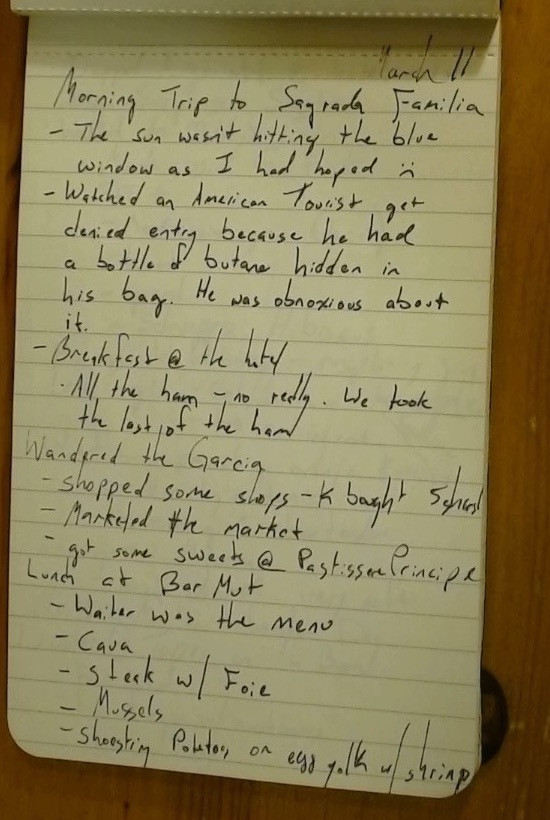
I went back to the Sagrada Família in the morning. The sun wasn’t hitting the blue windows the way I had hoped, but I still wanted another look before leaving. At breakfast in the hotel, we ate the last of the ham we’d bought.

We wandered through Gràcia, shopped a little, and picked up sweets at Pastisseria Príncep. Lunch at Bar Mut included cava, steak with foie, mussels, and potatoes with egg yolk and shrimp.

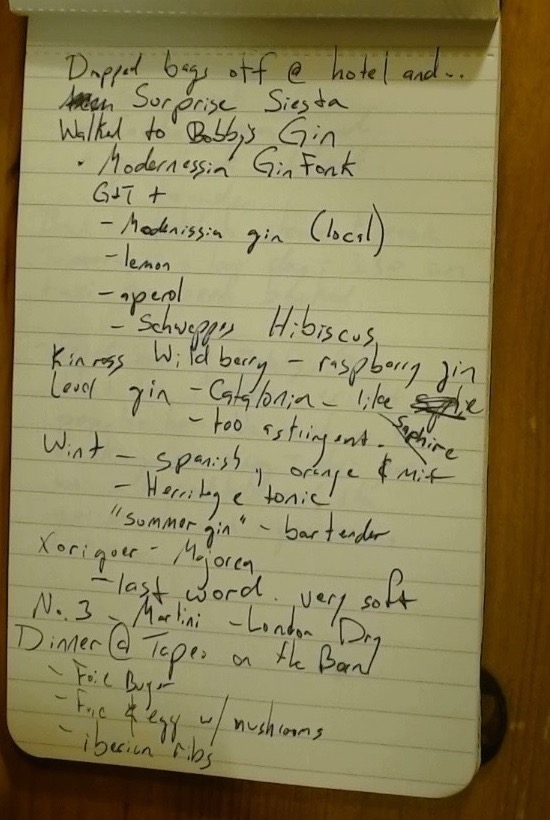
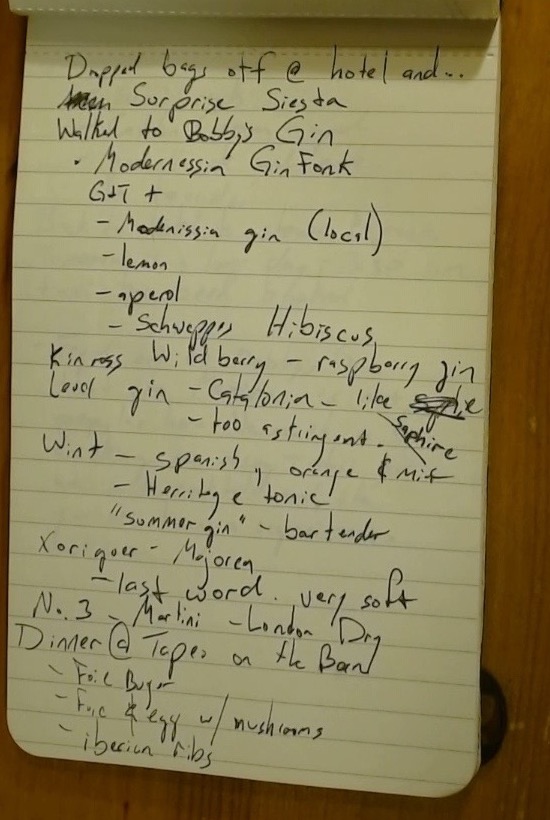
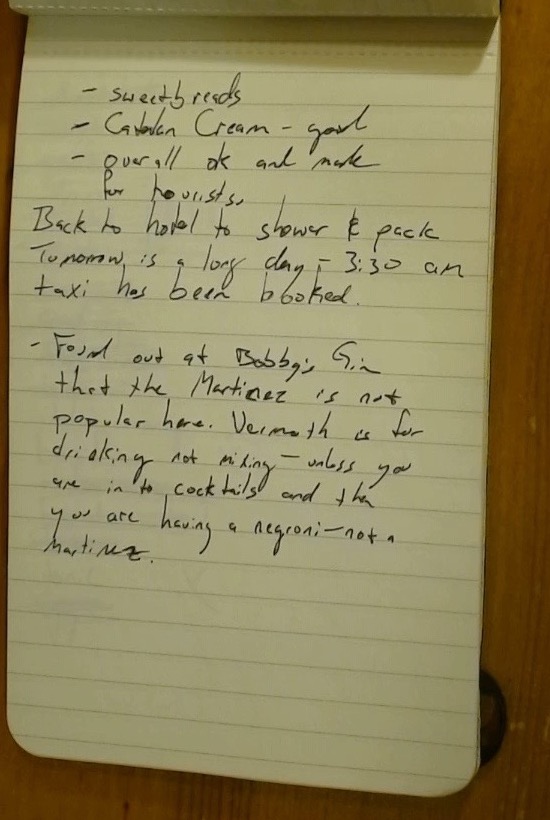
After a surprise siesta, we walked to Bobby Gin where I had a serious round of gin and tonics. The bartender explained that here vermouth is for sipping, not mixing, unless you are making a Negroni. Dinner was at Tapeo del Born: a foie burger, foie and egg with mushrooms, Iberian ribs, sweetbreads, and Catalan cream, which was good. It felt a little more touristy than some of our other meals, but the food was still good. Ksenia liked it more than I did. We went back to pack, shower, and face a very early flight.

Part of my March 2017 Barcelona trip. Trip summary.

From the Notebook

Barcelona notebook page 1, 2017-03-11

Barcelona notebook page 2, 2017-03-11

Barcelona notebook page 3, March 11, 2017

Barcelona notebook page 4, March 11, 2017

Travel, Food comments edit

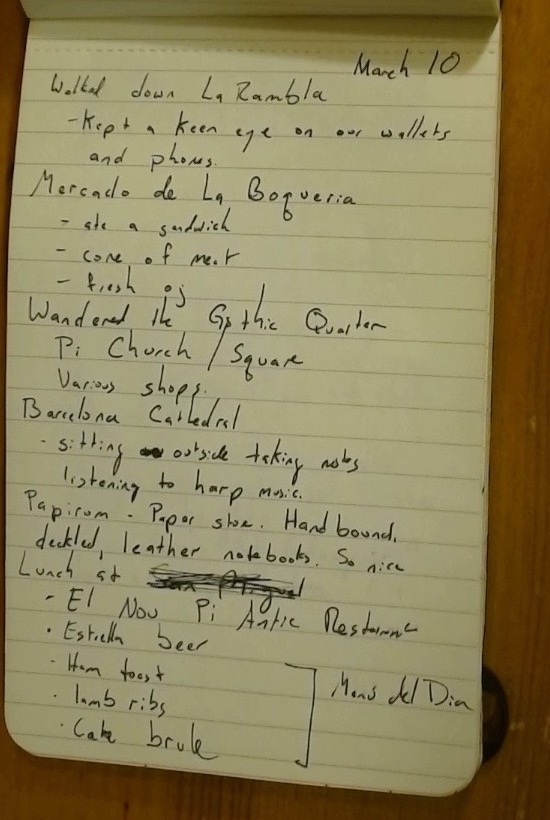
We walked down La Rambla, keeping an eye on our wallets and phones, and stopped at La Boqueria: a sandwich, a cone of meat, and fresh juice. Then we wandered through the Gothic Quarter, past the cathedral, into shops, and into a paper store with hand-bound leather notebooks. That store, Papirum, was very much my kind of place.

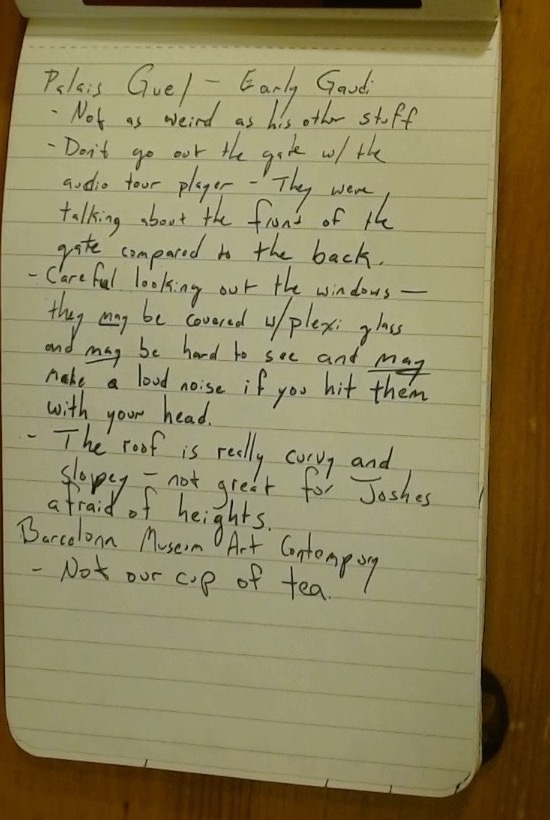
Lunch was at El Nou Pi Antic: Estrella beer, ham toast, lamb ribs, and crema catalana. At Palau Güell I liked the early Gaudí details, though the curvy, sloping roof was not great for my fear of heights. We also visited MACBA, which was emphatically not our cup of tea.

Part of my March 2017 Barcelona trip. Trip summary.

From the Notebook

Barcelona notebook page 1, 2017-03-10

Barcelona notebook page 2, 2017-03-10